How to Analyze Your Content for SEO and AI Search
Analyze your content for SEO and AI search with the 51 checks behind my post score. See what each one measures, how, and why.

On this page
Quick answer
Exibran's score checks each blog post against 51 things in 7 parts, from keywords and URLs to answer-first writing and fresh dates, and turns them into a number from 0 to 100. A score of 80 or more is good. Fix what the score flags before you publish.
Analyzing your content for SEO and AI search means checking each post against a list before it goes live. I do it by scoring every post out of 100 on 51 checks.
Here is exactly what each check measures, how it is measured, and why it is there.
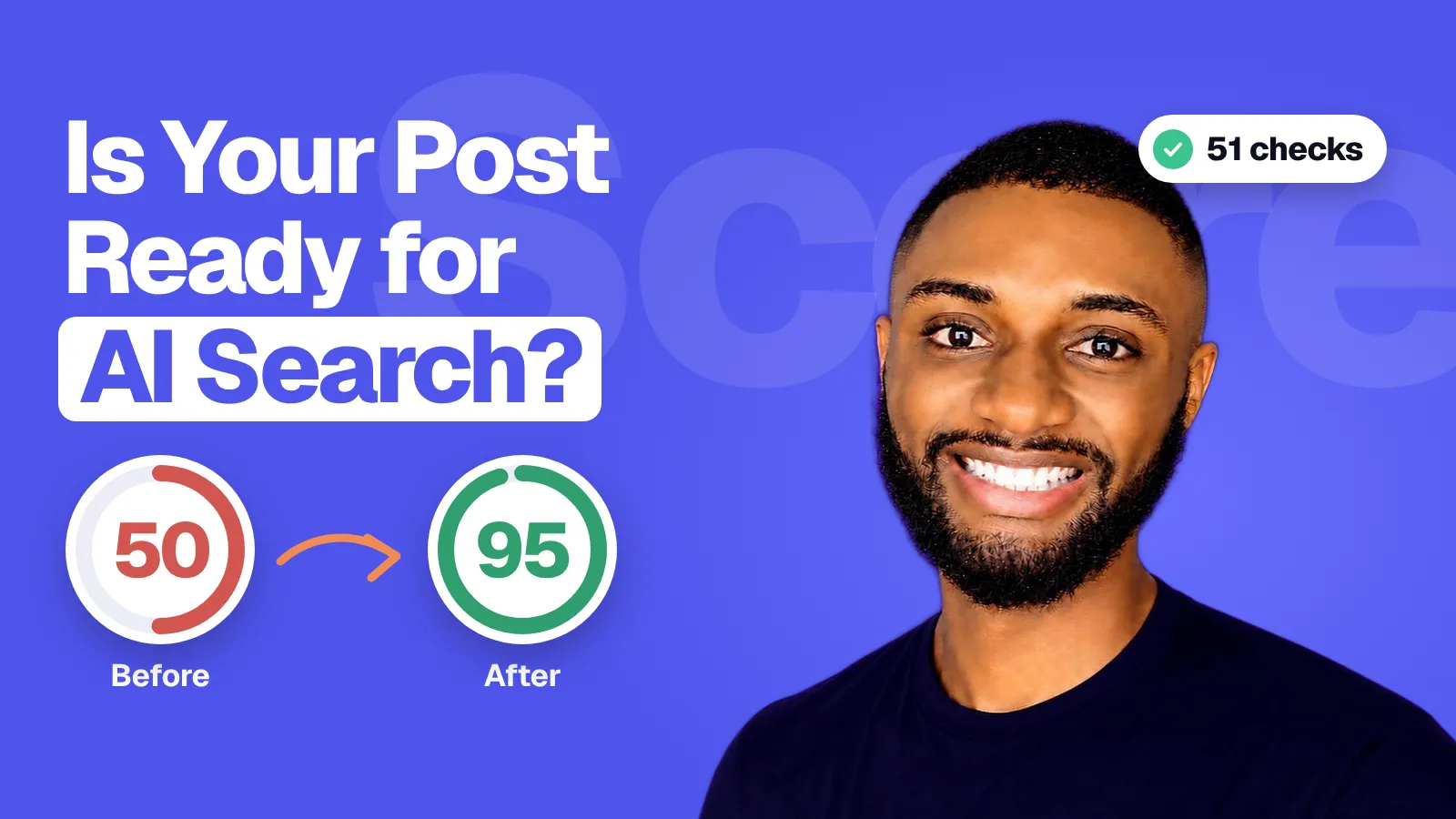
One of my posts scored 50 out of 100. I fixed what the score flagged and it came back at 95. I added alt text to my images, wrote key takeaways, put the answer first, added a quick answer, added more images and cut my long sentences down.
Key takeaways
- The score checks 51 things in 7 parts and gives each post a number from 0 to 100.
- Each check is worth 1 to 3 points. A pass earns all of them, a near miss earns half, and a fail earns none.
- Short posts and posts with no focus keyword are capped, so thin posts can't score well.
- A high score does not promise ChatGPT will mention you. It shows you did not miss the basics.
- Some checks come from Google and from research. A few are my own rules, and I say which.
How Do You Analyze Your Content for SEO and AI Search?
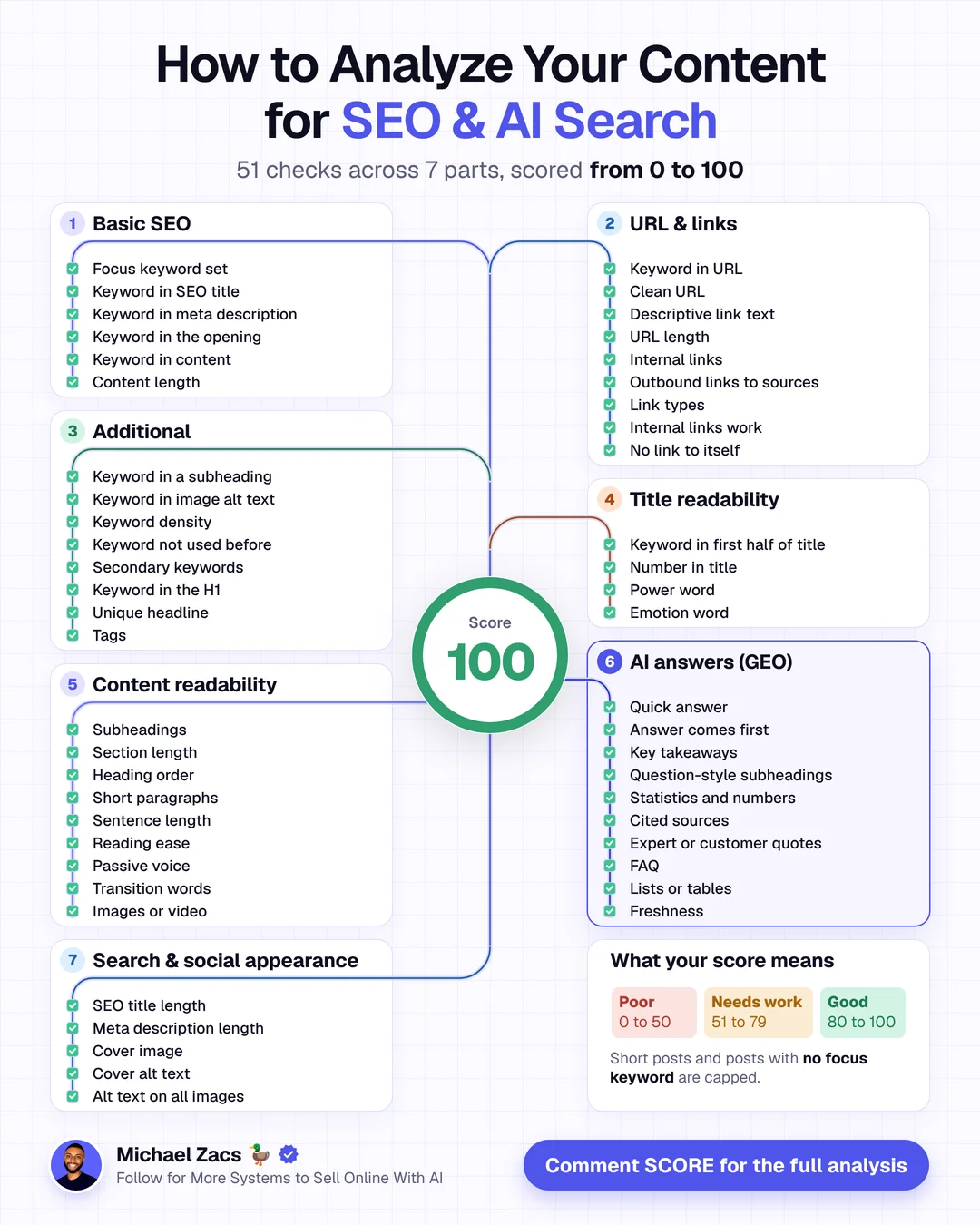
You analyze your content for SEO and AI search by scoring each post against a set of checks. My score measures how well a post is built for Google and for AI search.
It does not measure whether the post will rank or be mentioned. It runs 51 checks in 7 parts and turns them into one number from 0 to 100.
Here is everything it checks, so you can steal it:
- Basic SEO: your main keyword and how much you write.
- URL and links: your address, your links and your sources.
- Additional: keyword use, your headline and your tags.
- Title readability: whether people would click your title.
- Content readability: whether the post is easy to scan and read.
- AI answers (GEO): whether the post gives an answer that can be quoted.
- Search and social appearance: how the post looks in Google and when someone shares it.
Some checks come from Google's own guidance and some from research. A few are my own rules. I tell you which as we go.
How Is the SEO and AI Search Score Worked Out?
The SEO and AI search score is worked out from points. Each check is worth 1 to 3 points. A pass earns all of them, a near miss earns half, and a fail earns none.
The score is the points earned out of the points on offer, shown from 0 to 100.
- 80 or more is good.
- 51 to 79 needs work.
- 50 or below is poor.
Two things hold a score down. A post under 300 words can't score above 45, and a post under 600 words can't score above 65. A post with no focus keyword can't score above 60. A thin post should not look good just because the small details are tidy.
What Does the Basic SEO Part Check?
The Basic SEO part checks that your post is built around one main keyword and is long enough to cover it. The focus keyword is the phrase a buyer would type or ask.
- Focus keyword set. You fill in one main phrase. Every other keyword check measures against it, so a post without one can't score above 60.
- Keyword in SEO title. The focus keyword is in the SEO title. Google says (opens in a new tab) a few descriptive terms in the title can help, so I put the buyer's own words there.
- Keyword in meta description. The keyword is in the meta description. Google sometimes uses it as the snippet (opens in a new tab) under your title, so it is often the line a reader sees before they click.
- Keyword in the opening. The keyword is in the first 10% of the post, or in the quick answer. Readers decide in the first lines if you answer their question, so the keyword belongs there.
- Keyword in content. The keyword is in the body at least once. A post that never says what it is about is hard to place, so the keyword must appear at least once.
- Content length. 1,000 words or more passes, 600 to 999 is a near miss, and under 600 fails. This is my rule for covering a question properly. Google says (opens in a new tab) "there's no ideal page length," so treat 1,000 as my bar, not a law.
What Does the URL and Links Part Check?
The URL and links part checks that your address is clean and that your links help the reader. It covers the slug, the links to your own pages and the links to your sources.
- Keyword in URL. The main words of the keyword are in the slug. Google recommends readable words in URLs (opens in a new tab), not long ID numbers.
- Clean URL. Lowercase words joined by hyphens, with no more than two filler words. Google recommends hyphens between words, not underscores.
- Descriptive link text. No links that say "click here" or "read more." Google gives "Click here to learn more" (opens in a new tab) as its example of bad link text.
- URL length. 60 characters or fewer passes, and up to 75 is a near miss. Short addresses are easier to read and share, so I keep them short. This is my rule.
- Internal links. At least 2 links to your own pages. Google says the link text of internal links helps people and Google find your other pages.
- Outbound links to sources. At least 2 links to other sites that back up your claims. The reader can check what you said, because every claim points to its source. The Princeton GEO study (opens in a new tab) found that citing sources made content more visible in AI answers.
- Link types. This flags a post where every outside link is marked nofollow or sponsored. Links to sources you trust should be normal links. Use sponsored only for paid links.
- Internal links work. Every link to another post on your blog goes to a post that exists. A broken link sends the reader nowhere, so I check each one.
- No link to itself. The post does not link to its own address. That link is wasted, so link to a related post instead.
What Does the Additional Part Check?
The Additional part checks how you use the keyword, your headline and your tags. It is mostly about using the keyword naturally and keeping each post distinct.
- Keyword in a subheading. The keyword, or a close version, is in an H2 or H3. Subheadings tell readers what each section covers, so the keyword helps them find their place.
- Keyword in image alt text. The cover image or an image in the post has alt text with the keyword. Google says (opens in a new tab) to use keywords appropriately in alt text and not to stuff them in.
- Keyword density. The keyword makes up 0.5% to 2.5% of your words. More than 3% fails. Google calls it keyword stuffing (opens in a new tab) when you repeat the same words so often that it sounds unnatural.
- Keyword not used before. No other post of mine has the same focus keyword. Two posts aimed at one phrase end up competing, so I update the older post instead. This is my rule.
- Secondary keywords. Each related phrase you list shows up in the body at least once. These are the other ways your reader would say it, so they also help you match their words.
- Keyword in the H1. The headline readers see has the keyword, not only the SEO title.
- Unique headline. No other post has the same title. Two identical titles make two pages look like duplicates, so give each post its own.
- Tags. At least 2 tags. They connect related posts on my site, so readers can find the next one.
What Does the Title Readability Part Check?
The Title readability part checks whether people would click your title. It is four small checks, worth 1 point each, so they never carry a post.
- Keyword near the start. The keyword is in the first half of the title. The first words are the ones people still see when a title gets cut short, so put the keyword there.
- Number in title. The title has a number. A number tells the reader what they get, for example "51 checks."
- Power word. The title has a strong word such as proven, simple, mistakes or guide.
- Emotion word. The title has a clearly positive or negative word, such as best, win, stop or avoid.
What Does the Content Readability Part Check?
The Content readability part checks that your post is easy to scan and easy to read on a phone. It measures headings, paragraph size, sentence size and plain wording.
- Subheadings. 3 or more H2 headings pass, or 2 for a short post. Subheadings let a reader scan, so they find the part they need.
- Section length. Sections average 300 words or fewer between headings. 301 to 450 is a near miss. Long unbroken stretches are hard to scan on a phone.
- Heading order. No skipped levels, like an H3 with no H2 above it. The W3C says (opens in a new tab) skipping heading levels can be confusing and should be avoided.
- Short paragraphs. Paragraphs average 80 words or fewer, and none runs past 120.
- Sentence length. Sentences average 20 words or fewer, and no more than 25% run past 25 words.
- Reading ease. A Flesch reading ease (opens in a new tab) score of 50 or higher passes, and 30 to 49 is a near miss. Flesch scores of 60 to 70 mean plain English, and 50 to 60 is fairly difficult. I set the bar at 50 so technical posts can still pass.
- Passive voice. 10% of sentences or fewer passes, and up to 20% is a near miss. Active sentences say who does what, so the reader never has to guess.
- Transition words. At least 20% of sentences use words like because, so, but or for example. They link one idea to the next.
- Images or video. At least one image or video in the post. A screenshot or a chart shows the reader proof instead of just words.
What Does the AI Answers (GEO) Part Check?
The AI answers part checks whether the post gives a clear answer that a person or an AI tool can quote. Google says you do not need to write in a special way for its AI features, and I agree. These checks are good writing first.
They also match what researchers found. In the Princeton GEO study, citing sources, adding quotations and adding statistics each raised visibility in AI answers by a relative 30 to 40% on one measure.
The study used a test setup and Perplexity.ai, and it says results vary by topic.
- Quick answer. A quick answer of 30 to 80 words. I aim for 40 to 60. It answers the main question in one passage that someone can lift. Nobody has published a study showing 40 to 60 words is best. It is my rule.
- Answer comes first. The opening paragraph is 70 words or fewer, and 71 to 110 is a near miss. Say the answer first, then explain.
- Key takeaways. 3 to 6 one-line takeaways. A reader who skims also leaves with the main points.
- Question-style subheadings. At least 2 subheadings phrased as questions. People type questions into AI apps, so headings in that shape match what they ask.
- Statistics and numbers. At least 5 figures in the post, not counting years. The Princeton study found that adding statistics raised visibility.
- Cited sources. At least 2 sources listed, or 1 source plus at least 2 outbound links. The same study found that citing sources raised visibility.
- Expert or customer quotes. At least one quote in the post. The same study found that adding quotations raised visibility.
- FAQ. At least 3 real questions with short answers. Google stopped showing FAQ rich results from 7 May 2026 (opens in a new tab), so this check is not about getting a rich result. It is about answering the questions a buyer really asks.
- Lists or tables. At least 2 lists or tables. Steps and comparisons are easy to scan, so they are easy to lift.
- Freshness. Updated in the last 180 days passes, and up to 365 days is a near miss. Ahrefs (opens in a new tab) looked at 17 million citations across 7 AI search platforms and found that AI assistants cite pages that are 25.7% fresher than organic Google results. Google's AI Overviews did not show that pattern.
What Does the Search and Social Appearance Part Check?
The Search and social appearance part checks how the post looks in Google and when someone shares the link. It covers the title, the description and the images.
- SEO title length. 30 characters or more, and short enough to fit about 60. Google says there is no limit on title length, but it cuts titles down to fit the screen, so I keep mine short enough to show whole.
- Meta description length. 120 characters or more, and short enough to fit about 140. Google has no limit here either, but it cuts the snippet to fit the device width.
- Cover image. A cover image is set. It is the picture shown when someone shares the link. The Open Graph standard (opens in a new tab) defines og:image as the image that represents the page.
- Cover alt text. At least 10 characters that describe the cover. Google calls alt text the most important image detail, and it helps people who use screen readers.
- Alt text on all images. Every image in the post has alt text.
How Did I Take One Post From 50 to 95?
I took one post from 50 to 95 by fixing the six things the score flagged. Here is each fix next to the check it cleared:
- Added alt text to my images. Cleared the alt text on all images check.
- Wrote key takeaways. Cleared the key takeaways check.
- Put the answer first. Cleared the answer comes first check.
- Added a quick answer. Cleared the quick answer check.
- Added more images. Cleared the images or video check.
- Cut my long sentences down. Cleared the sentence length check.
The post is Why Does ChatGPT Recommend My Competitors and Not Me?. Here is its score in the Exibran editor today.
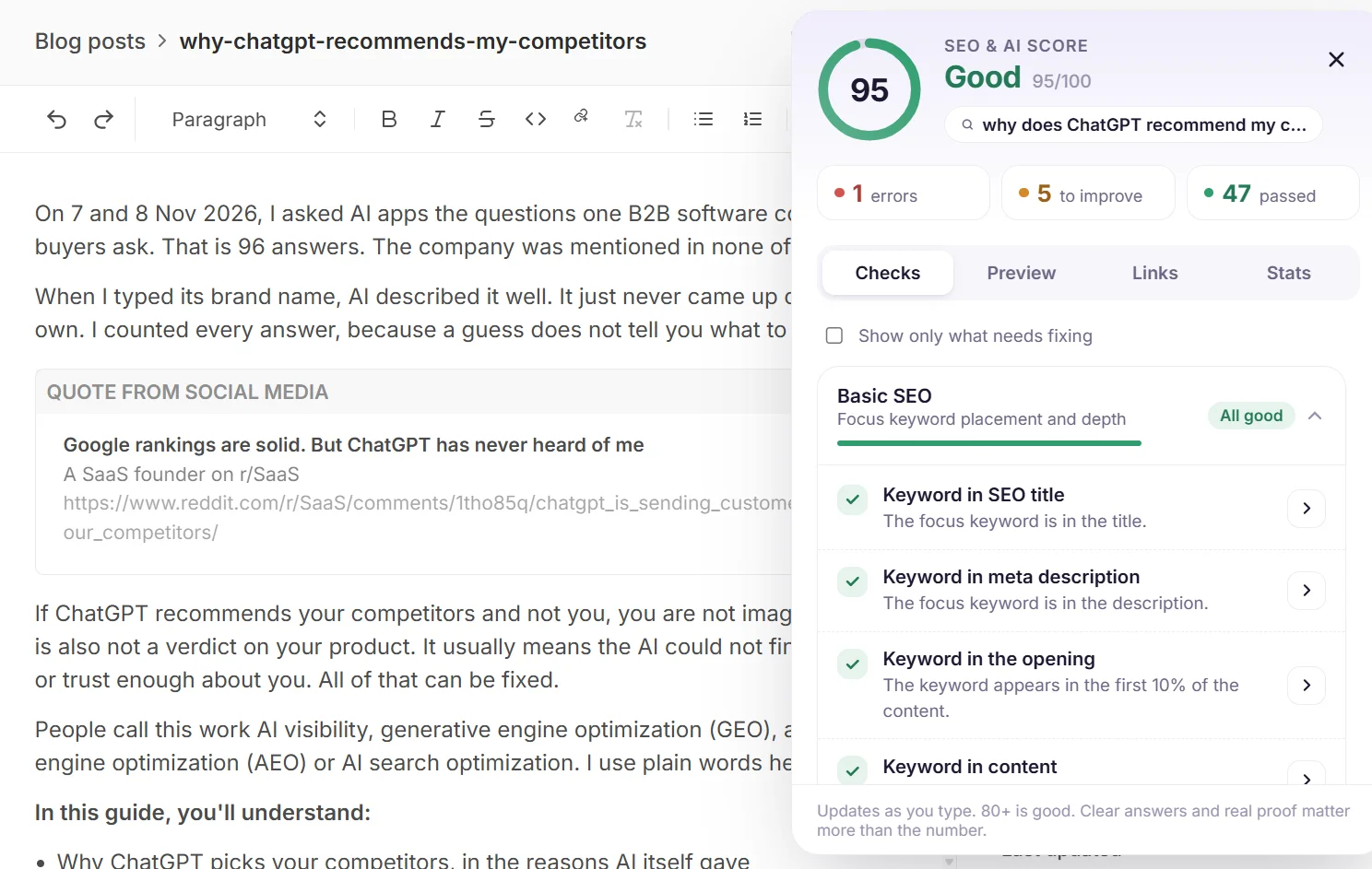
None of these is hard. Doing all of them on every post is where I slip, so I built the score to do the remembering for me.
Why Does a Good Score Not Promise ChatGPT Will Mention You?
A good score does not promise that ChatGPT will mention you, because the score measures how the post is built and not what an AI tool decides. Three limits are worth knowing.
- Nobody controls the answer. AI tools choose what to include. A well-built post gives them something clear to quote, but that is all a score can show.
- Google says you do not need special tricks. Its guide says you do not need special markup, AI text files or Markdown to appear in its AI features, and that there is no ideal page length. My 1,000 word bar and my 40 to 60 word quick answer are my own rules.
- A few checks only show up when something is wrong. A noindex tag makes the post fail, because Google will drop a noindex page from search results entirely (opens in a new tab). A canonical tag that points to another address shows a warning, because Google uses the canonical to choose which URL people see (opens in a new tab).
What to Do Now
You now know what each check measures and why it is there. A good score means the post is built well. It does not mean AI will mention you.
Run your next post through the 51 checks before you publish, fix what fails, and aim for 80 or more. Then analyze your content for SEO and AI search again each time you update a post.
You can check a blog post for SEO and AI search by hand with the PDF checklist, or let a tool do it while you write.
I am building a system that checks all of this for you automatically while you write and share. If you do not want to miss it, join the WhatsApp community (opens in a new tab).
Frequently asked questions
Does a high score make ChatGPT mention my post?
A high score does not make ChatGPT mention your post. It shows the post is built well: clear answer, sources, numbers, good structure. Nobody can promise a mention, because the AI tool decides what to include.
Do I need a tool to check my content for SEO and AI search?
You do not need a tool to check your content for SEO and AI search. You can run through the 51 checks by hand with the PDF checklist. A tool only does it faster, while you write.
What score should I aim for before I publish?
Aim for a score of 80 or more before you publish. In my score, 80 or more is good, 51 to 79 needs work, and 50 or below is poor.
Are all 51 checks equally important?
The 51 checks are not equally important. Each one is worth 1 to 3 points. Quick answer, statistics and cited sources are worth 3 each, while the title word checks are worth 1.
Published
Add Exibran as a preferred source on GoogleJoin the conversation
Comments
Comments are closed on this post.
Bran’s waiting for the first comment
Ask a question, share what AI says about your brand, or tell Michael where you disagree. You will get a reply.