What Is Exibran Radar, and How Does It Measure What AI Says?
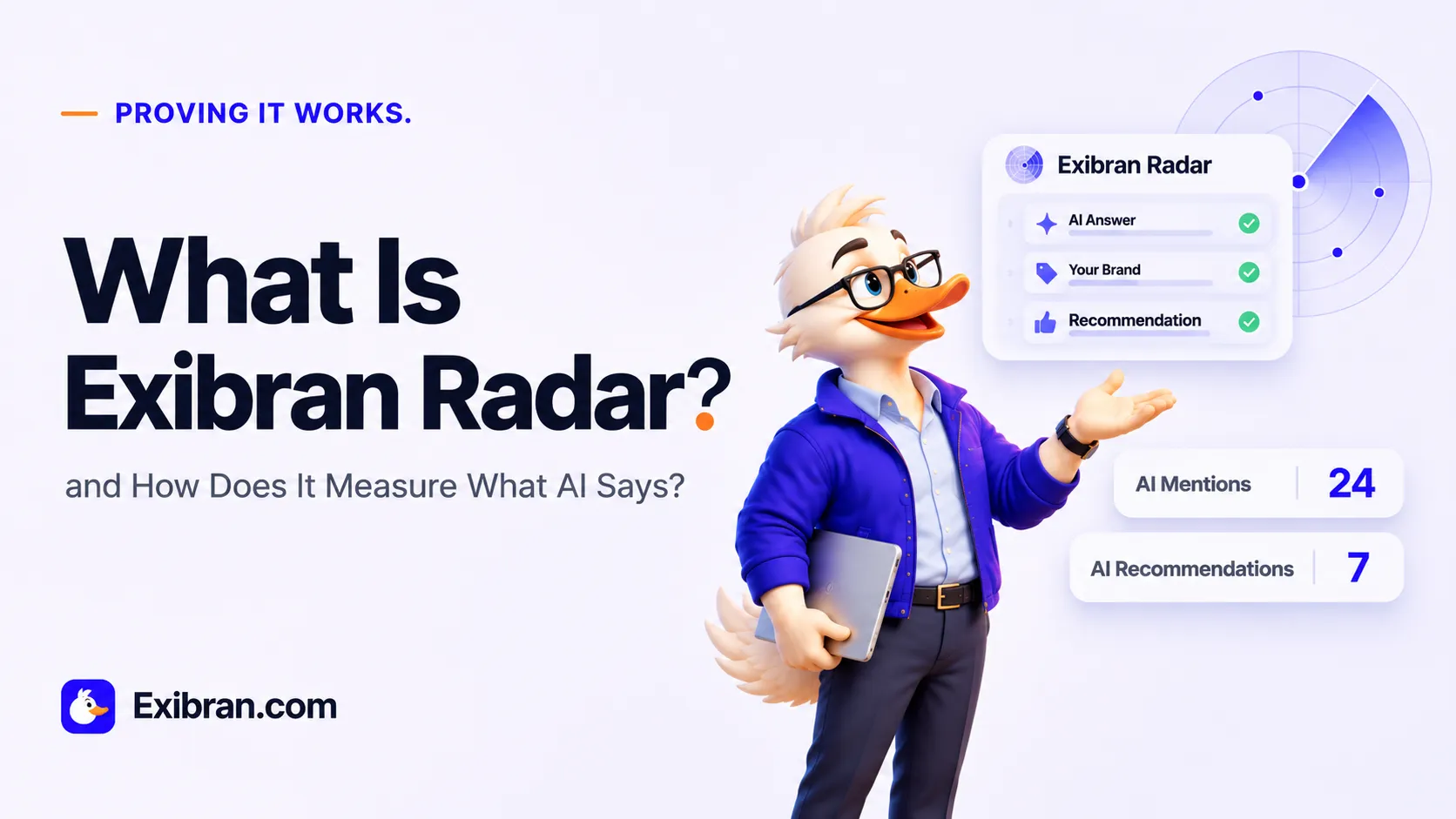
Exibran Radar is the private tool I use to ask AI assistants a business's buyer questions, save every answer, measure who gets picked and show why. What it does and where it falls short.

On this page
Quick answer
Exibran Radar is the private tool I use to measure what AI assistants say about a business. It asks your buyers' questions many times, saves every answer word for word, separates a mention from a pick, shows why AI picks others, tracks change over time and turns it into a ranked plan. It is not sold as software.
Exibran Radar is the tool Exibran uses to find out what AI assistants say about a business. I run it for my own research and for client work.
This page explains what it does, so you can judge the numbers I publish. I update it when Radar changes, and it has changed a lot since the first version.
Key takeaways
- Radar asks the AI apps your buyers' questions many times and saves every answer word for word.
- It separates a mention from a pick. Being listed is not being chosen.
- Every rate comes with a 95% range, and a change only counts when the ranges do not overlap.
- It shows the reasons AI gave for its picks and what the cited pages have in common, then turns that into a ranked plan. The reasons are not proof of cause.
- The free check gives a report from 75 answers: your AI Pick Rate with its range, who AI recommends instead and why, whether AI can read your site and two fixes you can apply today.
- It is a private tool for my own research and client work, not a public product.
What Is Exibran Radar?
Exibran Radar is a private tool that asks AI assistants the questions your buyers ask, saves every answer, and measures who gets recommended.
A Private Tool That Asks AI Your Buyers' Questions
You give me a business name, buyer's location, and a website. Radar works out what the buyers ask, then asks the AI tools those questions many times.
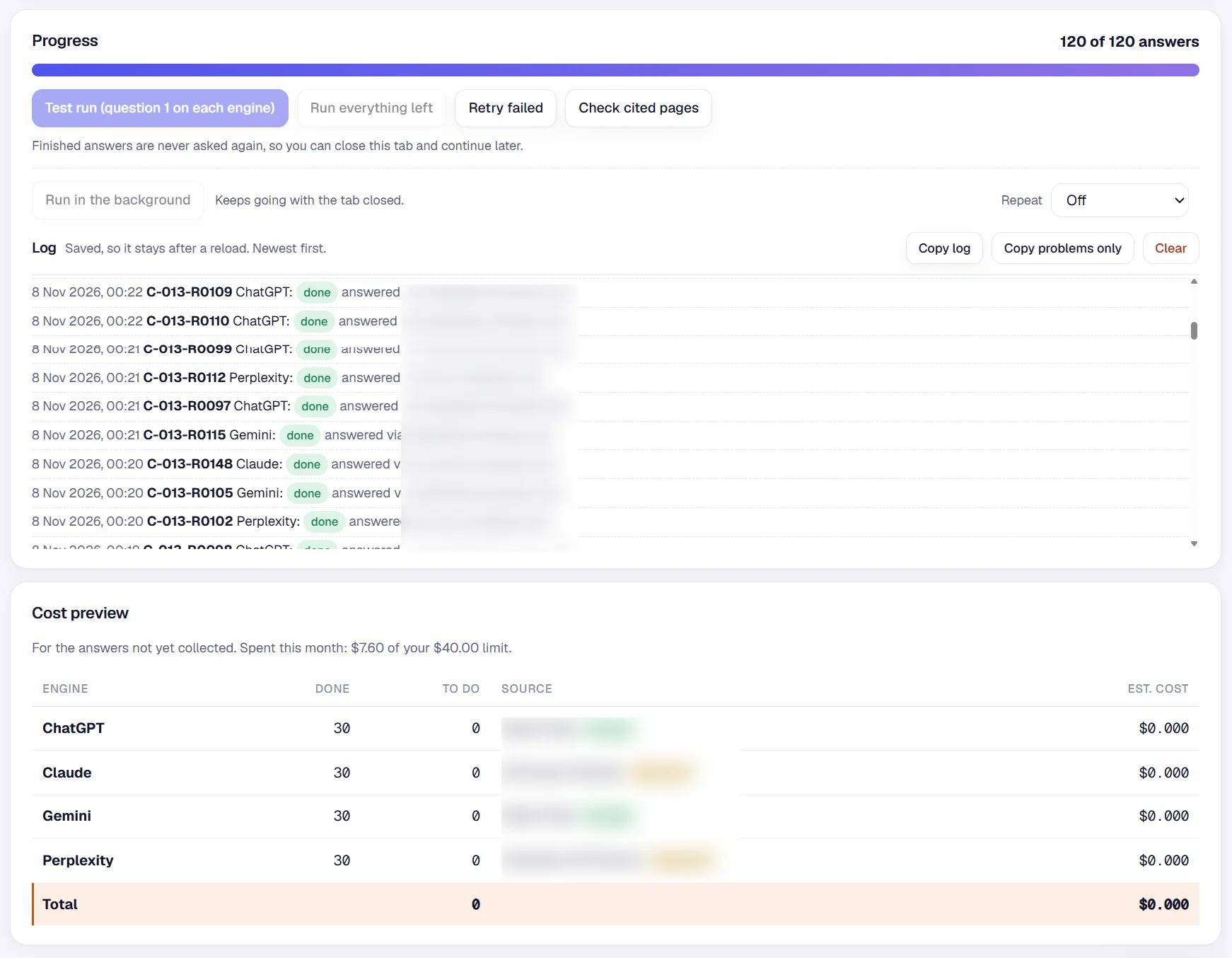
It saves every answer word for word and records which brands each answer mentions.
The result is a set of numbers, the real answers behind them, and a report I check before it goes anywhere.
Who Uses It, and Is It for Sale?
Exibran Radar is used by me and my clients. It is not a public product.
Me and My Clients
Radar is not for sale as software, and there is no sign-up. I run it myself.
The Index reports, such as the November 2026 Index, come from it, and so do the free AI visibility checks and client reports. If I ever open it up, I will say so here.
How Does It Work?
Exibran Radar goes from a business name to a client report in six steps. Every step keeps the evidence, so you can check my work.
Six Steps, From Business Name to Client Report
- Understand the business. I start from the website and research who buys and what they ask. Radar looks in places like Reddit, forums, review sites and the company's own communities, and checks every link it finds. A link only counts when the page loads and the words are really there.
- Write buyer questions. They cover the stages a buyer goes through, from first searching the category to comparing options and checking trust. I label how I found each question, so an observed question is never mixed up with an inferred one.
- Ask the AI apps. Each question is asked several times on each app, with the country and language set. Radar saves when each request was made and when the answer came back.
- Read every answer. Radar records which brands were mentioned, in what order, which sites were cited, and whether one brand was picked.
- Explain the picks. Radar looks at the reasons AI gave and at the pages it cited. More on that below.
- Review and report. I read the answers, fix the tags and write the report. I send it as a private link or a PDF.
How Does Radar Know a Tool Was Picked?
Exibran Radar separates a mention from a pick, because being listed is not being chosen.
It Separates a Mention From a Pick
A mention means the brand appears anywhere in the answer.
A pick means the answer's own verdict chooses the brand, for example, "I'd go with X" or "best overall: X". Being listed first is not a pick.
It's also what you call "AI recommends a product."
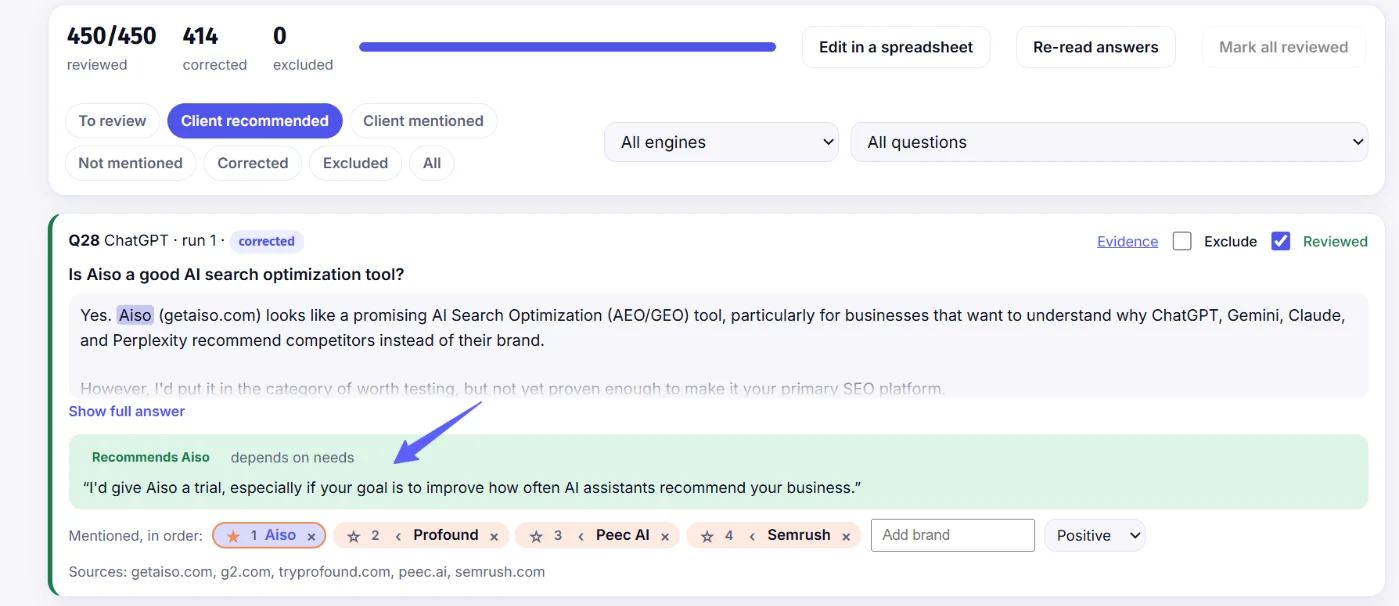
Radar tags both, and I check the tags against the answer text. I can star or unstar a pick, and re-read the answers when I change a brand spelling rule.
Old answers follow the new rules, so the numbers never disagree with each other. The full definitions are in the AI Pick Rate guide.
Radar can also measure its own reading. A second review of a sample of answers, and a spot check against the real app, show how reliable the tags are.
How Does Radar Count Without Fooling Me?
Exibran Radar shows every rate with a range, because AI answers change from one ask to the next.
Ranges, Ties, and a Seven Point Rule
Each rate comes with a 95% range. A change counts as real only when it is at least 7 points, and the old and new ranges do not overlap. Anything else is shown as "no real change".
If two brands have ranges that overlap, they share a rank. You will see "=2" in a report, not a made-up winner.
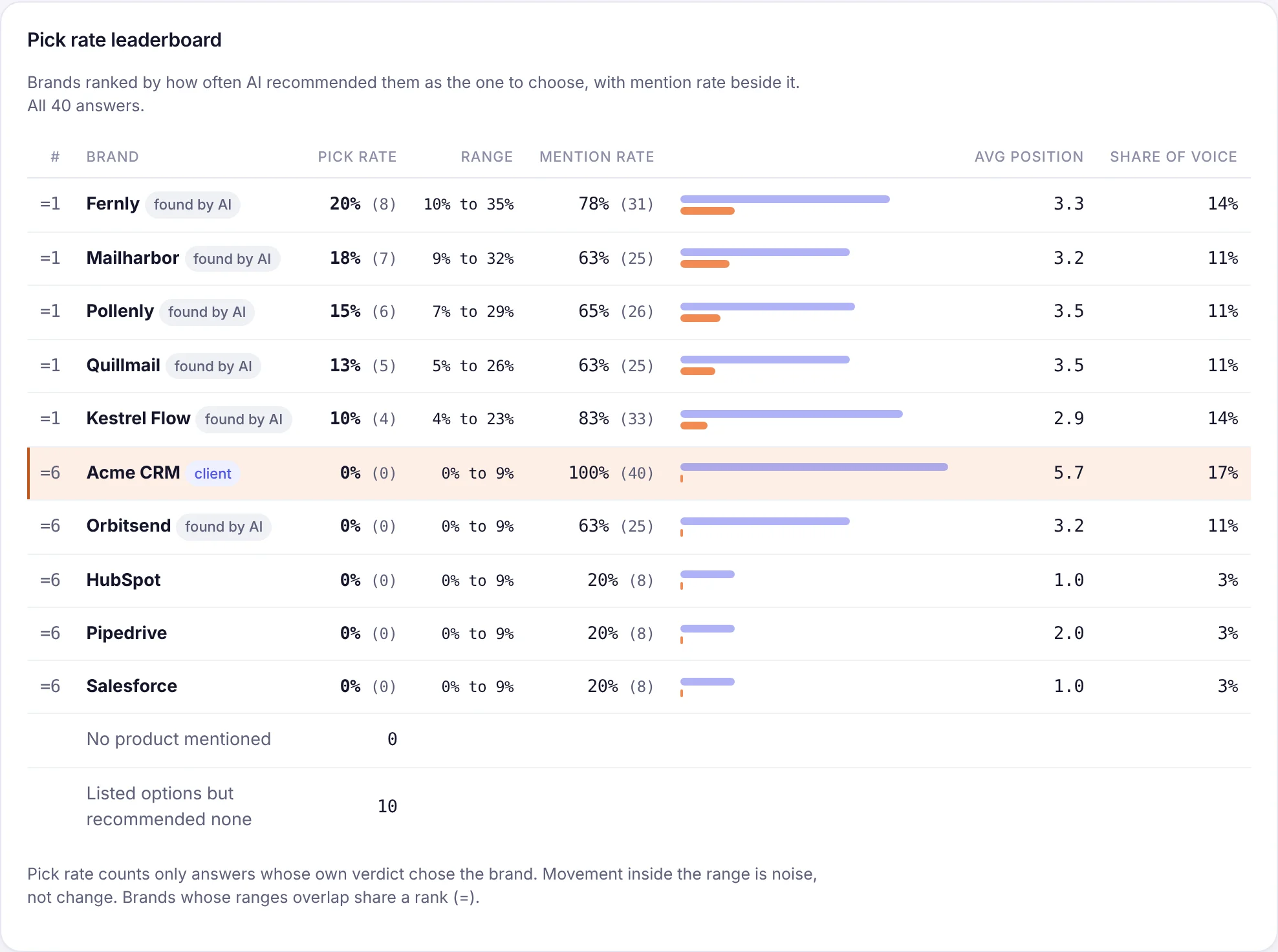
Example check on a demo business.
Questions that name your own brand are left out when checks are compared with each other, so every check is counted the same way. And the headline, the brand table, the report, and the spreadsheet all read the same counted answers. They cannot disagree.
What Does It Report?
Exibran Radar reports your rates with their ranges, and the answers behind every number.
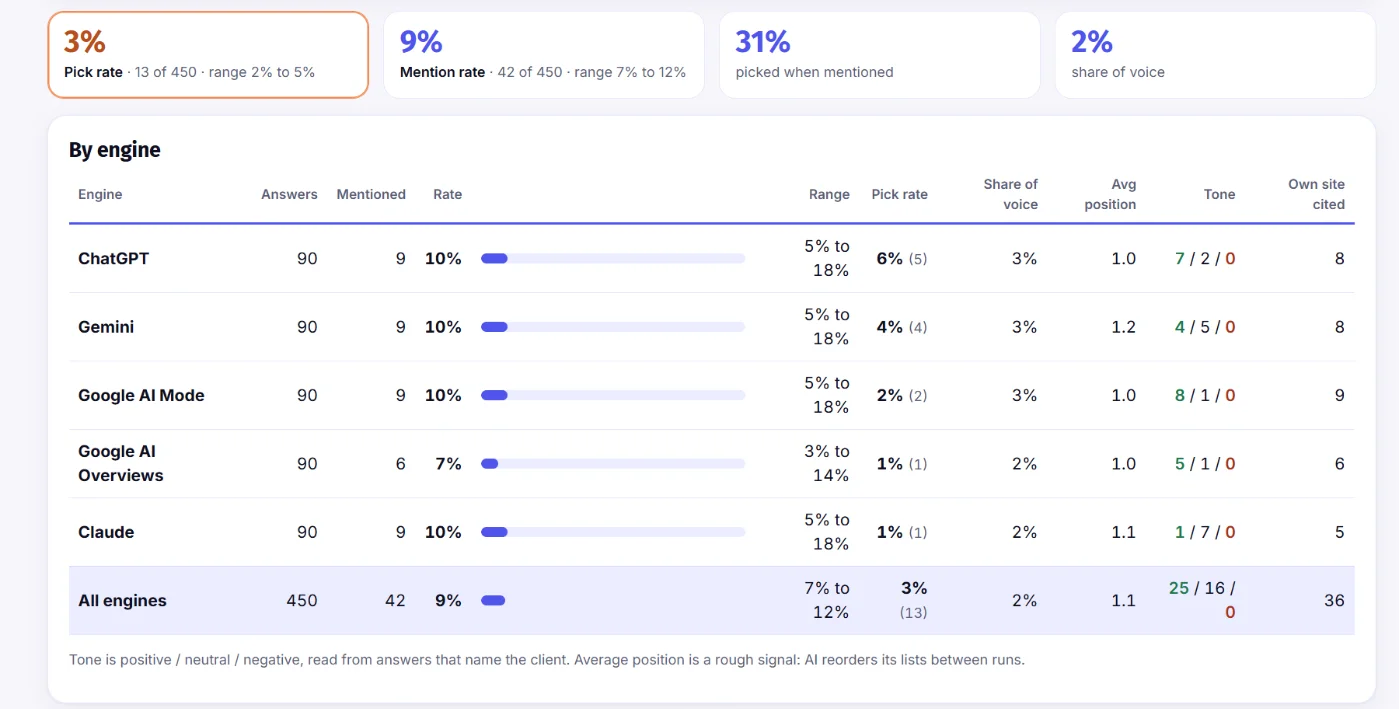
Rates With Ranges, Plus the Answers Behind Them
- Visibility and AI Pick Rate, each with a 95% range, so small gaps show up as ties.
- Share of voice and tone, so you can see how much of the conversation your brand gets and how AI talks about it.
- Results by AI app, so you can see which one favours you and which does not.
- Questions that name your brand against questions that do not. The ones that do not are the real test.
- Which brands AI picks instead, and what it says about them.
- Which sites AI cites, and where your competitors are listed and you are not.
- Before and after, when a check is repeated.
- A spreadsheet of everything, with every answer, cited address, and number, so you can check it yourself.
Can Radar Show Why AI Picks a Competitor?
Exibran Radar shows the reasons AI gave for its picks. It does not prove why AI chose one tool, and I say so wherever it appears.
The Reasons AI States, Sorted and Counted
For every answer that recommends a brand, Radar keeps the sentences about that brand and sorts them into reasons, like price, ease of use or integrations.
When a sentence turns on "but" or "however", the part after it is counted as a limit, not a reason.
Then it compares. If AI says a rival is picked for something it never says about you, that shows up as a gap, with the real sentences next to it.
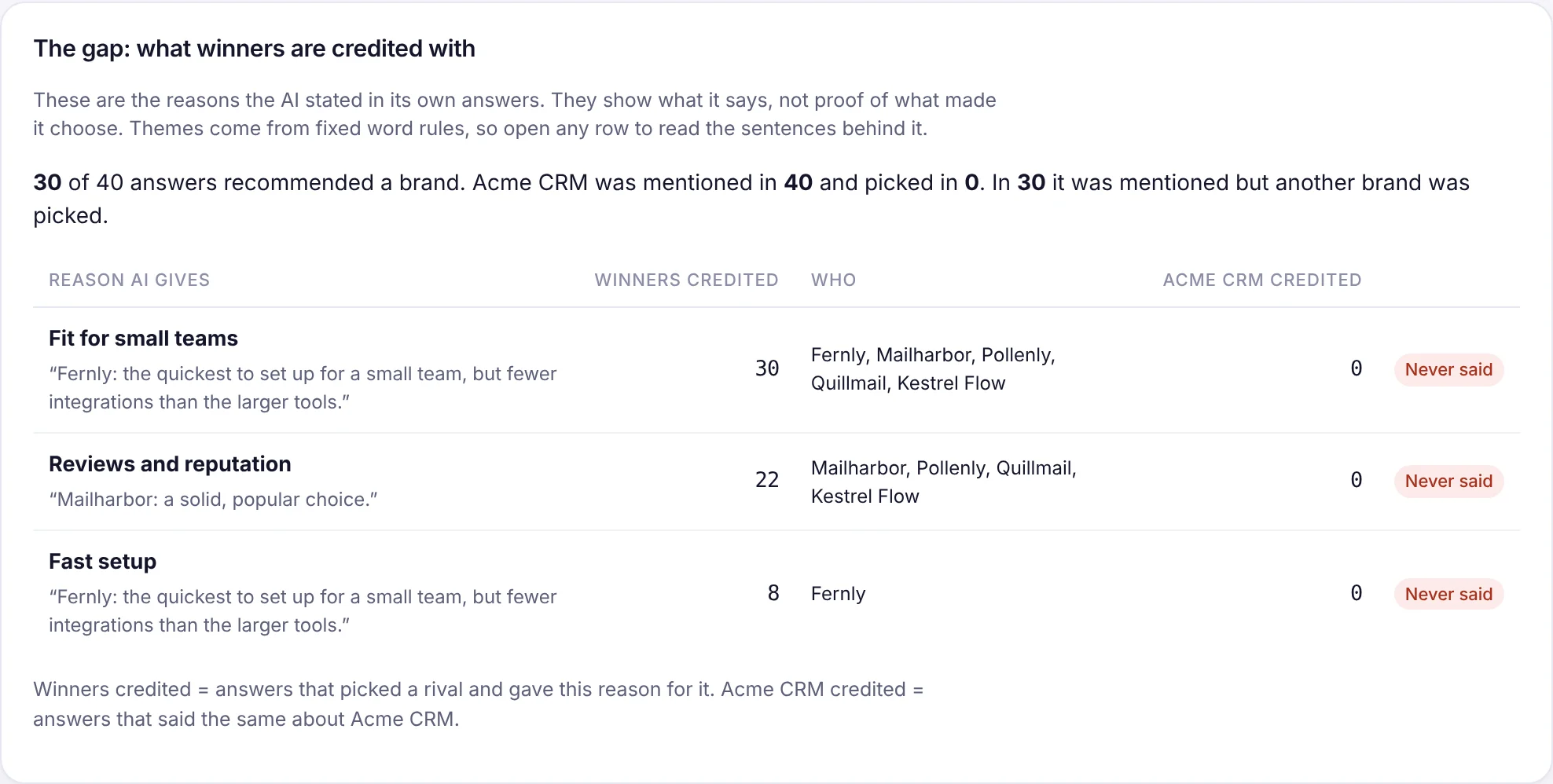
Example check on a demo business.
What the Pages AI Cites Agree On
Radar reads the most cited pages from other sites and lists the claims they make about each brand. A claim is only kept when its sentence is on the page word for word.
When two or more pages say the same thing about a brand, I call it an agreed claim. One page is only a mention.
The Path From Question to Pick
For each question, Radar can show the searches the AI chatbot ran, the sites it read, the sites it cited and the brand it picked.
One plain sentence says where you drop out: picked, mentioned but not picked, cited but not mentioned, read but not cited, or not read at all.
I can also ask the AI app to explain its own recommendation. That reply is the model's own account, not proof. And these trails come from the AI apps' own search tools, not the apps you open on your phone, so they can differ.
What Do the Pages AI Cites Have in Common?
Exibran Radar counts what is on the pages AI cites, and checks your own pages against the same list.
Page by Page, and Across the Whole Site
For every cited page, Radar counts things like tables, figures, quotes, pros and cons, a short answer at the top, pricing and FAQs. It also lists buyer questions that no cited page answers in its title or headings.
The Audit tab then runs 33 fixed checks on the most cited pages and on your key pages, in five groups: technical, structure, content, messaging and proof. You can compare any of your pages against any other page, and see which page types AI cites that your site does not have.
Each item carries a label for how much evidence stands behind it. Research means a study measured it, like the Princeton GEO paper (opens in a new tab). Seen means cited pages had more of it, which is a pattern only. Guess means I found no study. A score is not a prediction.
Does Anyone Actually Search for These Questions?
Exibran Radar checks which of your buyer questions people also type into Google, using Google's own suggestions.
A Signal, Not a Search Volume Count
Radar has no search volume, and I will not pretend it does. It takes the search phrase inside each question and asks Google what it suggests. The result is High, Medium, Low or None.
Long, detailed questions are labelled Situation. People put those to AI. They do not type them into Google (sometimes, do), so Radar never calls them "no demand".
A question becomes a priority when people search for it, and you are mentioned in under a third of its answers.
Can Radar Track Change Over Time?
Exibran Radar can repeat a check every week, every 2 weeks or every month, and tell me when something moves.
Repeats and Change Alerts
A repeat copies the check, asks the same questions again and compares the new answers with the last check. It follows the same counting rules, so a small wobble is not announced as news.
I get an alert when your visibility falls or rises beyond the noise. I also get one when a competitor's range moves clear above where it was, and it is mentioned in at least 10% of answers. If the ranges overlap, nothing is flagged.
Can Radar See Visits From AI Apps?
Exibran Radar can show visits from AI apps next to what the answers say, when a client connects Google Analytics.
Read-Only Google Analytics, Three Months at a Time
The client adds a read-only viewer to their Google Analytics property. Radar then pulls sessions by month and keeps the ones that came from ChatGPT, Perplexity, Gemini, Copilot, Claude, Grok and DeepSeek.
Treat the numbers as a floor. Some AI visits arrive with no source and land in Direct. Google AI Overviews and AI Mode arrive as Google. Radar shows who arrived, not who bought.
What Do I Do With the Findings?
Exibran Radar turns what it finds into one ranked action plan, so the report ends with what to do first.
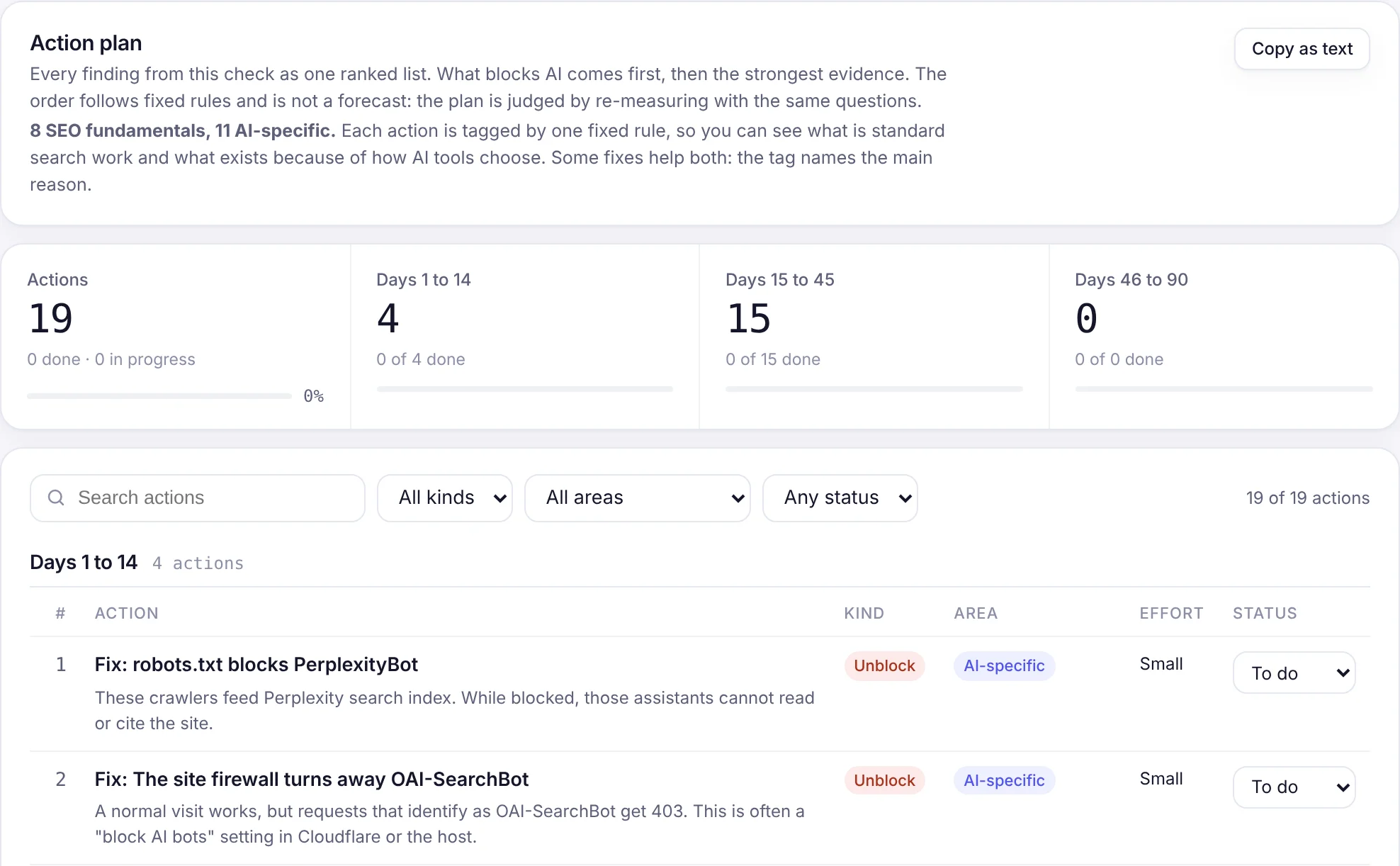
One List, in a Fixed Order
The plan has five kinds of action:
- Unblock: site problems that stop AI crawlers or readers.
- Get listed: sites AI cites that list your competitors and not you.
- Say it: reasons AI gives for your rivals that nobody says about you.
- Create: page types AI cites that your site does not have.
- Improve: pages AI opened but did not cite, and checks most cited pages pass and yours do not.
Each action carries the finding with its numbers, the effort, and a phase: days 1 to 14, 15 to 45, or 46 to 90. The order follows fixed rules. It is not a forecast of results.
Every action also carries one of two tags. SEO fundamentals are standard search work that helps on Google anyway, such as readable pages, clear headings and structured data.
AI-specific actions exist because of how AI tools choose what to recommend, such as letting AI crawlers in, getting named on the sites AI cites and answering the reasons AI gives for your rivals.
Some fixes help both, so the tag names the main reason. One fixed rule sets it, not my judgment each time, so you can see what you are paying for.
Example check on a demo business.
What Else Does It Check?
Exibran Radar checks whether AI crawlers can read the site at all.
Whether AI Crawlers Can Read the Site
Radar also checks whether the major AI crawlers are allowed on a site and whether its pages can be read by them.
A blocked crawler can keep a good product out of AI answers. These are the first fixes in a report, because nothing else matters if the door is shut.
What Is in the Free Check?
The free AI visibility check runs on Exibran Radar with a fixed size, so the numbers are steady enough to be useful.
75 Answers From 3 AI Apps
It asks ChatGPT, Gemini and Perplexity 5 buyer questions, and each question is asked 5 times on each app. That is 75 answers.
I picked more runs over more questions on purpose. AI answers swing from run to run, so extra runs steady the numbers more than extra questions do. With 75 answers the range is about 11 points either side at 50%. Per app it is about 19 points, so I treat the app-by-app numbers as a direction, not a verdict.
You get the result by email within 48 hours, with no call and no card.
What Is in the Free Report
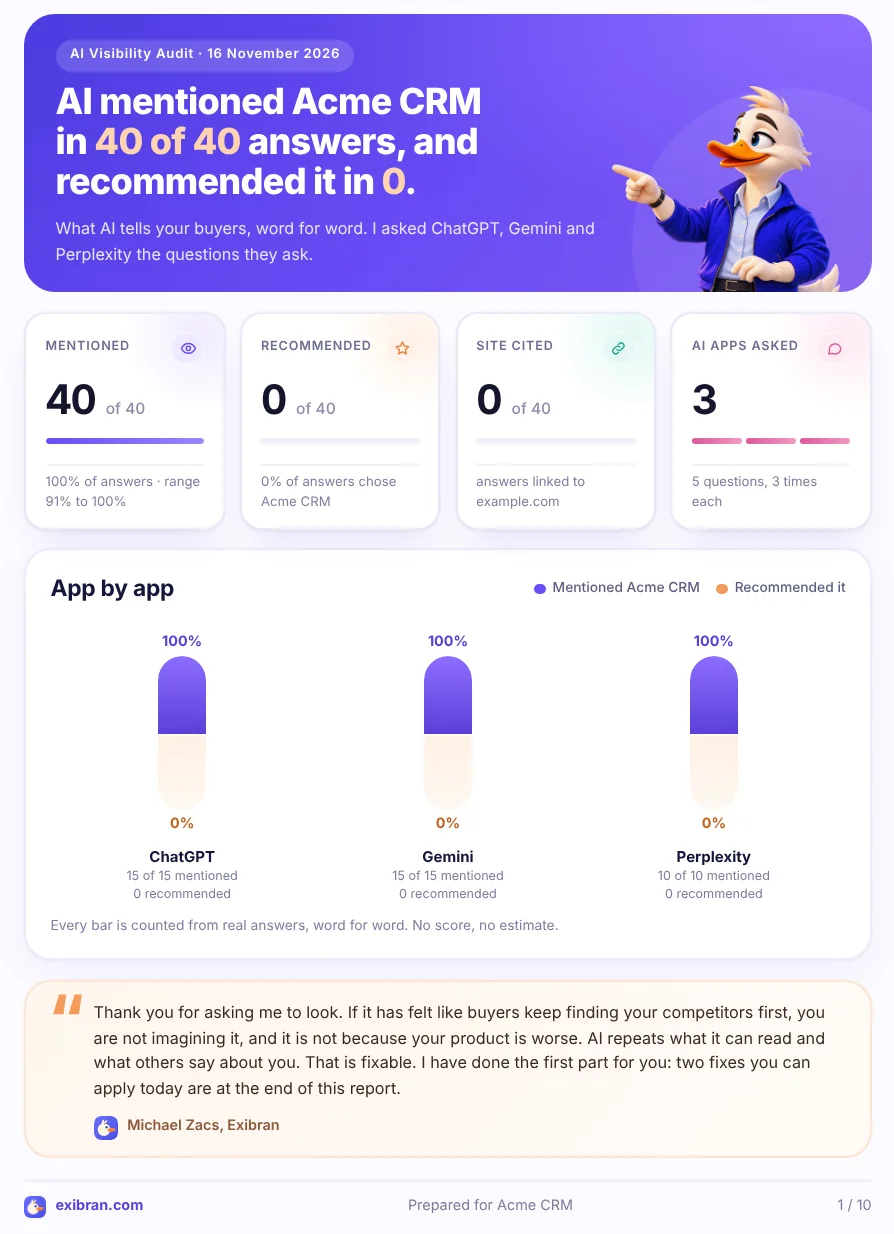
The free report is built from those 75 answers. It has:
- Your AI Pick Rate, with its range, and how it splits by AI app.
- Who AI recommends instead of you, and the reasons it gives for them.
- A real answer, word for word, so you see what a buyer sees.
- Where AI gets its answers: the sites it cites, and the first 2 where competitors are listed and you are not.
- How your pages compare with the pages AI cites, and what those pages have that yours do not.
- What buyers need, as AI reads it, and the doubts it raises.
- Whether AI can read your site, including whether the main AI crawlers are allowed in.
- Two fixes you can apply today, written out and ready.
- A preview of the 90-day plan, with the other fixes shown as ready but locked.
- How I checked it, with the limits stated next to the numbers.
A section appears only when the check has the data for it. The page comparison, for example, needs your pages and the cited pages to have been read.
What Stays in the Paid Work
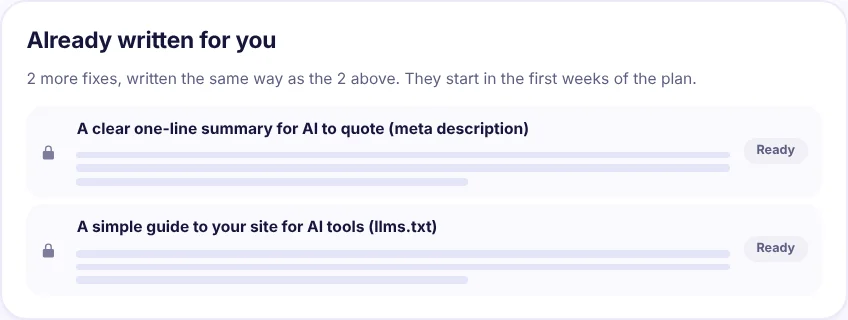
Example check on a demo business. The free report shows the problem and two fixes. These are not in it:
- The full ranked action plan, with every action tagged SEO fundamentals or AI-specific.
- Every fix written out, not just the first two.
- Every site where competitors are listed and you are not.
- Where your page can stand out, and what the cited pages say about each brand.
- Repeat checks, with before and after.
What the Free Report Does Not Do
It does not promise that AI will recommend you. It does not measure leads or sales, and it includes no outreach or writing.
Visits from AI apps appear only when a client connects Google Analytics, which is not part of the free check. It shows what AI says today, with a range, so you know where you stand before you spend anything.
Does Radar Have an Assistant?
Exibran Radar has a built-in assistant that answers questions about a check, using only numbers it reads from the check.
It Reads, and It Can Propose Changes I Confirm
I can ask it things like "where did we drop out on question 3?" and it reads the results again before every answer. It cannot delete, share or send anything.
When it proposes a change, such as marking a plan action done or starting a run, I see what it will do and what it costs, and I press Confirm. Most changes can be undone, as long as nothing newer has replaced them.
What Are Its Limits?
Exibran Radar measures what AI says, not what is true or what sells.
It Measures What AI Says, Not What Is True or What Sells
- AI answers change from ask to ask, so I ask each question several times and report ranges.
- The answers Radar collects may not match exactly what a person sees in the app… which is common.
- The tagging makes mistakes, which is why I review it. I am one reviewer, with AI help.
- The questions come from my research. A different list could give a different ranking.
- It saves the page link AI cited, but it can only read a page that loads for it. Pages behind a sign-in or a block are listed and not counted.
- The reasons AI gives are its own account, not proof of cause. A pattern across cited pages is not a cause either.
- The Google search signal shows that people type a phrase, not how many.
- Visits from AI apps are added only when a client connects Google Analytics. They show who arrived, not who bought. Leads are logged by hand, so they are a record I keep, not something Radar measures. It does not measure sales.
The methodology page covers how I apply it to the Index reports.
What Has Changed in Radar?
This is the log of what changed in Exibran Radar and when.
Changelog
- 16 November 2026: every plan action now carries an SEO fundamentals or AI-specific tag, and this page spells out what the free report contains and what stays in the paid work.
- 14 November 2026: rewrote this page to cover everything Radar does now.
- 13 November 2026: added repeat checks with change alerts, visits from AI apps (from Google Analytics), the Google search signal for each question, the free check size (75 answers), the action plan, the page and site audit, why AI picks them, agreed claims across cited pages, the path from question to pick, the research trail, the results dashboard, and the built-in assistant.
- 4 November 2026: first version of this page.
What Does AI Say About Your Product?
I run Radar for B2B SaaS teams at Exibran. You send your product name, and I send back the real answers, word for word, with your pick rate and its range.
Frequently asked questions
Is Exibran Radar available to buy or sign up for?
No. It is a private tool I use for my own research and for client work. If that changes, this page will say so.
Which AI assistants does Radar ask?
ChatGPT, Gemini, Perplexity, Google AI Mode, Google AI Overviews, Claude and others, depending on the job. The free check uses ChatGPT, Gemini and Perplexity. The November 2026 Index used five.
What is in the free check report?
A report built from 75 answers: 5 buyer questions, each asked 5 times on ChatGPT, Gemini and Perplexity. It shows your AI Pick Rate with its range, who AI recommends instead and why, the sites AI cites, whether AI can read your site, and two fixes you can apply today. It arrives by email within 48 hours.
Does Radar decide on its own which tool was picked?
No. Radar tags each answer first. Then I read the answers and fix the tags myself.
Can Radar tell me why AI picks a competitor?
It shows the reasons AI gave for its picks, which sites it cited and what those pages have in common, so you can see where a competitor appears and you do not. It cannot prove why an AI chose one tool over another.
Published · Last updated
Add Exibran as a preferred source on GoogleJoin the conversation
Comments
Comments are closed on this post.
Bran’s waiting for the first comment
Ask a question, share what AI says about your brand, or tell Michael where you disagree. You will get a reply.