AI Pick Rate: How Often AI Recommends Your SaaS, And How To Measure It
AI Pick Rate is the share of AI answers that recommend your product as the one to choose. The formula, how to measure it without fooling yourself, and what 405 real AI answers showed.

On this page
Quick answer
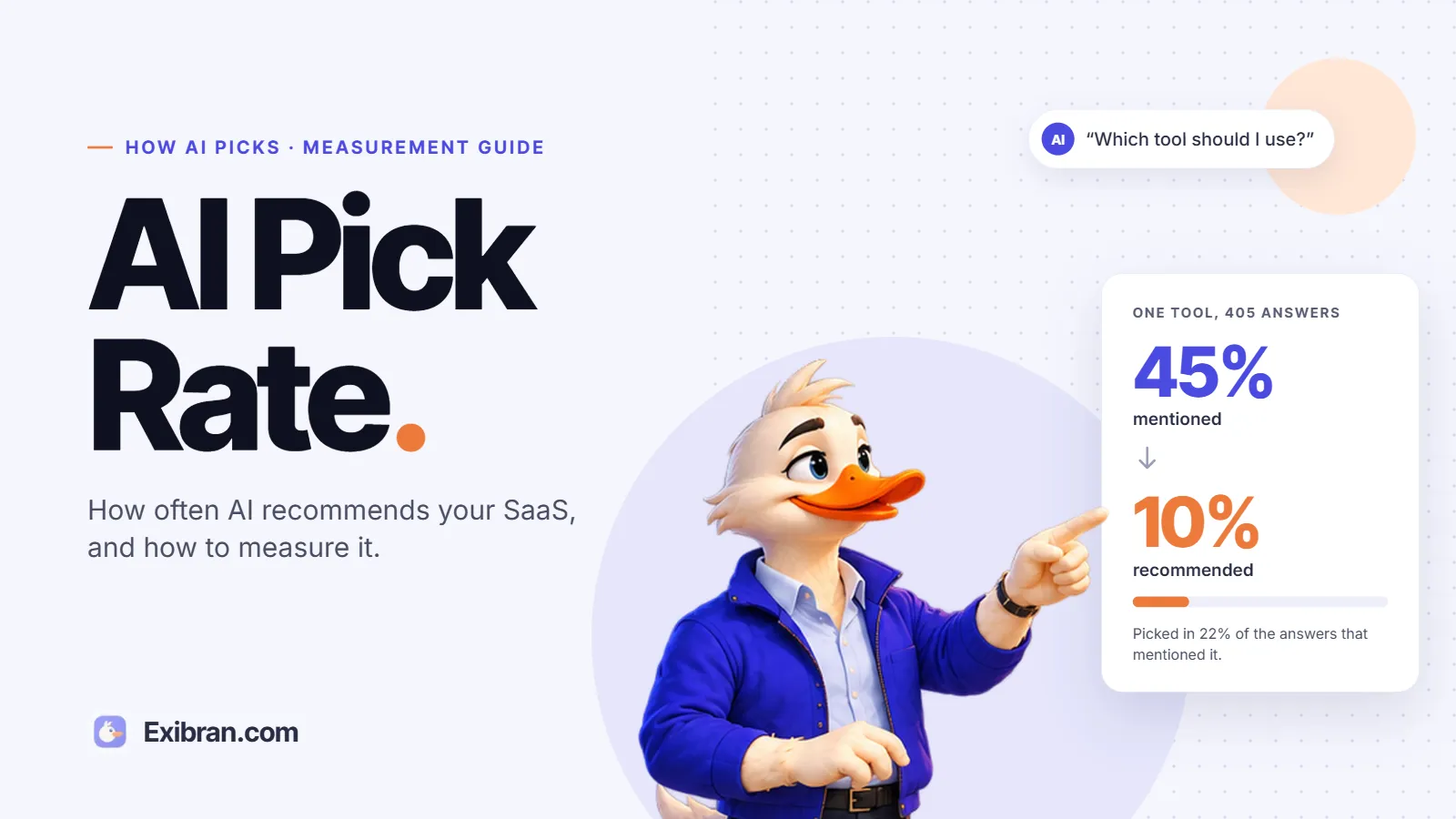
AI Pick Rate is the share of AI answers that recommend your product as the one to choose, not just mention it. Ask AI apps your buyers' questions many times, count the answers whose verdict picks you, and divide by all answers. In my test of 405 answers, the best tools were mentioned in about 45% of answers and picked in 10%.
Early this year, I watched a client's Google traffic drop while their articles were ranking high on Google.
They even appeared in AI Overviews and in Perplexity. The visits barely came. AI had already summarized what people used to click to read.
I said we should stop chasing random keywords and target high buyer intent only. The client pushed back.
They sent me more keywords and even asked me to use AI to blast out content to saturate them. I knew that was not the fix. People were not clicking through even after we gave them every answer.
That is when it clicked. Traffic was never the goal. Demos and qualified leads are. And buyers now ask AI which tool to pick, where a small SaaS is up against the big names in every answer.
At Exibran, I measure that with one number: AI Pick Rate.
In this guide, you'll understand:
- What AI Pick Rate is, and why a mention does not count
- What 405 real AI answers showed in one SaaS category
- How to measure your own AI Pick Rate, in five minutes and then properly
- Where AI reads about your brand, and what raises your pick rate
Key takeaways
- AI Pick Rate = answers that recommend you ÷ all answers, for a fixed set of buyer questions.
- Being mentioned is not being recommended. In my 405-answer test, the top tools were mentioned in 43% to 45% of answers and picked in 10%.
- Most AI answers pick nothing. Only 29% of the answers named a winner. 52% listed options and stopped.
- The AI apps disagree. Claude picked a tool in 42% of answers. Google's AI Overviews did in 19%.
- Report pick rate with a range, and read every answer. Software tagging needed fixes in 390 of 450 answers.
What Is AI Pick Rate?
AI Pick Rate is the share of AI answers that recommend your product as the one to choose, out of all the answers to a fixed set of buyer questions.
If AI recommends you in 15 of 100 answers, your pick rate is 15%. It counts the verdict, not the mention.
Below you get the method, the traps, and the numbers from a real test I ran on 405 AI answers.
Why Does Your AI Pick Rate Matter More Than Mentions?
Because your buyer chose what AI recommends (the verdict), not the list. Here is why pick rate matters more than mentions:
Buyers Now Start Their Research In AI
Half of B2B software buyers now start their research in an AI chatbot rather than Google, and AI chat is their top source for building a shortlist, according to G2’s survey of over 1,000 buyers (opens in a new tab).
So the AI answer is where your shortlist is decided.
Missing the AI Shortlist Costs You Deals
Co-founder of SalesMonk AI, Siddharth Goel, shows the cost in one of his LinkedIn posts (opens in a new tab): “We lost a deal last month because the buyer’s ChatGPT didn’t put us on the shortlist.”
One SaaS founder put it plainly: “My product wasn’t mentioned. Three competitors were.”
There is no page two. If AI names three tools and you are not one of them, that buyer never knew you existed, and you will not see it in your analytics either.
Being Mentioned Is Not The Same As Being Recommended
A typical answer names four to eight options, says a line about each, then closes with something like “For a small team, I’d go with X.”
You can sit in that list in almost every answer and still almost never be the X. Mentions count the list. Pick rate counts the X.
What Is The Difference Between Mentioned And Recommended?
Your AI Pick Rate only counts one of them. Mentioned means your name appears anywhere in the AI search answer. Recommended means the answer's own verdict chooses you.
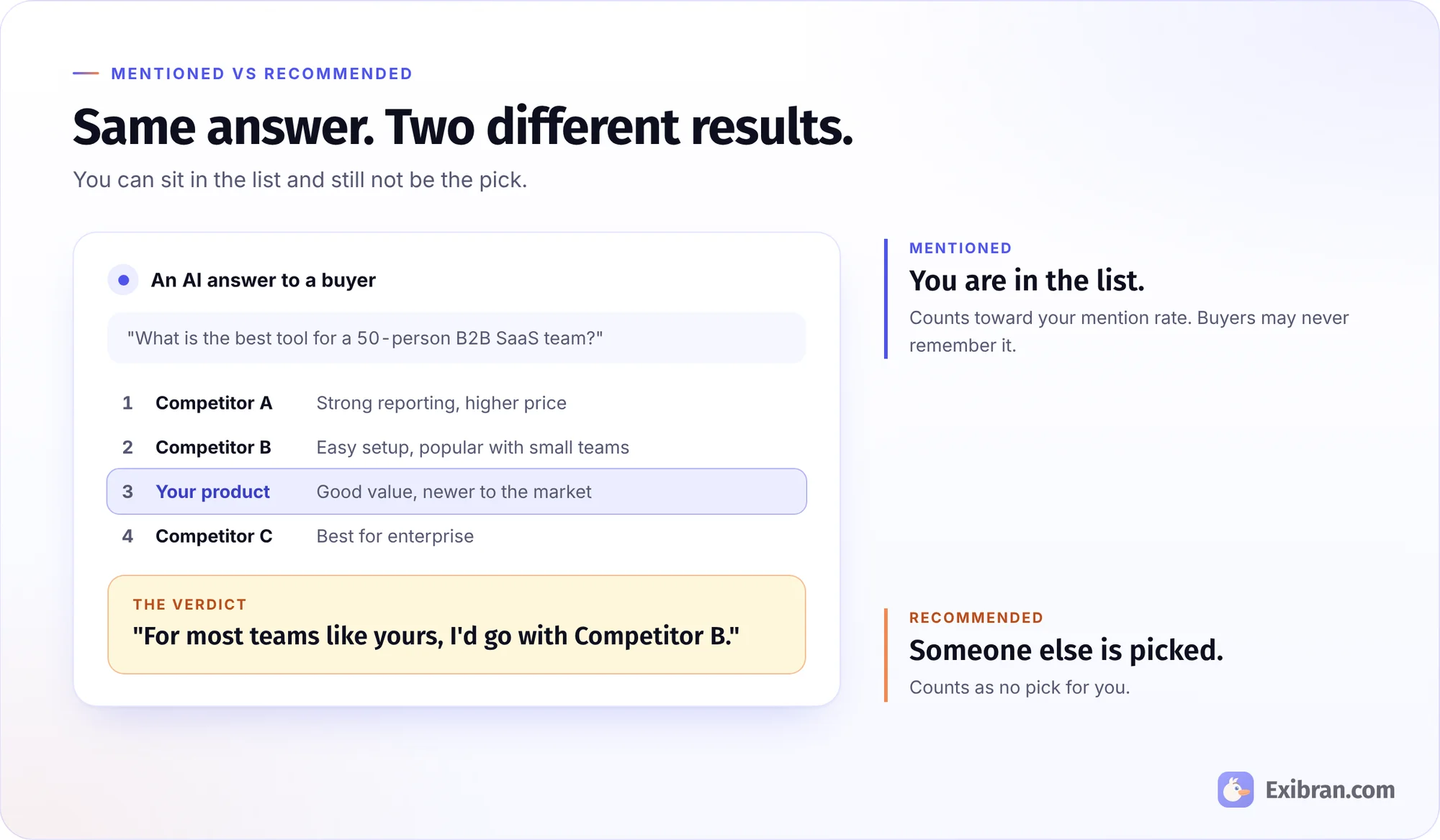
Those are different numbers. Keep them apart:
| Metric | What It Counts | The Question It Answers |
|---|---|---|
| AI Pick Rate | Answers whose verdict recommends you ÷ all answers | How often does AI tell buyers to choose us? |
| Mention Rate | Answers that name you anywhere ÷ all answers | Does AI know we exist? |
| Picked When Mentioned | Answers that recommend you ÷ answers that mention you | Once AI brings us up, does it back us? |
| Share Of Voice | Your mentions ÷ all brand mentions | How much of the conversation is about us? |
| Position | Where you appear in the order of brands | A rough signal only. It changes almost every time. |
"Picked when mentioned" is the one I watch most. If AI names you often but backs you rarely, it knows you and has a reason to prefer someone else. That is fixable. It is a very different problem from being unknown.
A mention can also be wrong. A mention with old pricing or the wrong features is not a win. That is why every answer needs a read, not just a name count.
What Did 405 Real AI Answers Show About Pick Rate?
I wanted proof, not opinions. So I ran the AI Pick Rate method on a category I know well: AI search optimization tools, using Exibran Radar, the tool I built for this.
Every brand in it sells the same promise, which is getting you recommended by AI. If any category should be good at it, this one should.
The setup
- 30 buyer questions across six stages: category, problem, comparison, alternatives, price and trust
- 5 AI apps: ChatGPT, Claude, Gemini, Google AI Mode and Google AI Overviews
- 3 runs of every question, so 450 answers
- 405 answers count. Three questions named the brand I tracked, so I left them out of the results.
The questions use the words buyers use, such as "ChatGPT recommends my competitors and never us. How do I fix that?" and "Is Profound worth the price for a $5M ARR SaaS?"
I tracked one brand in this category. It is not a client, and I am not naming it. This is a public measurement of what AI says, not client work.
I also tried Perplexity and Microsoft Copilot, but I could not collect their answers reliably, so they are not in these numbers.
The Brand I Tracked Was Never Mentioned
In my test, it appeared in 0 of 405 answers. Not once, on any of the five apps, at any buyer stage. Its pick rate is 0%, with a plausible range of 0% to 1%.
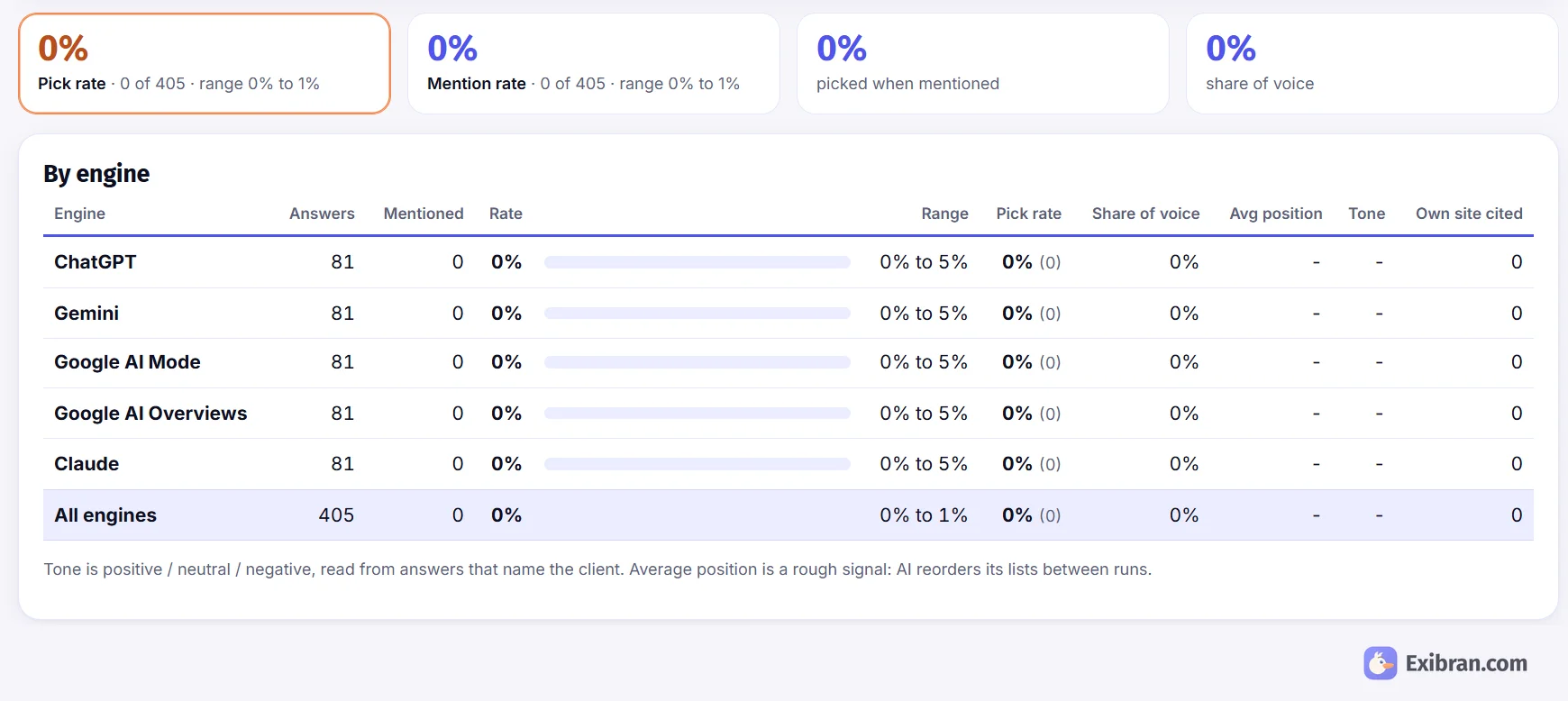
Its own website was not cited in any of those answers either. It only showed up when a question named it.
Top Tools Were Mentioned Far More Than Picked
In my test, three tools were mentioned in 43% to 45% of all answers. Each was picked in 10%.
Once AI brought one of them up, it backed it in only about one answer out of every four or five.
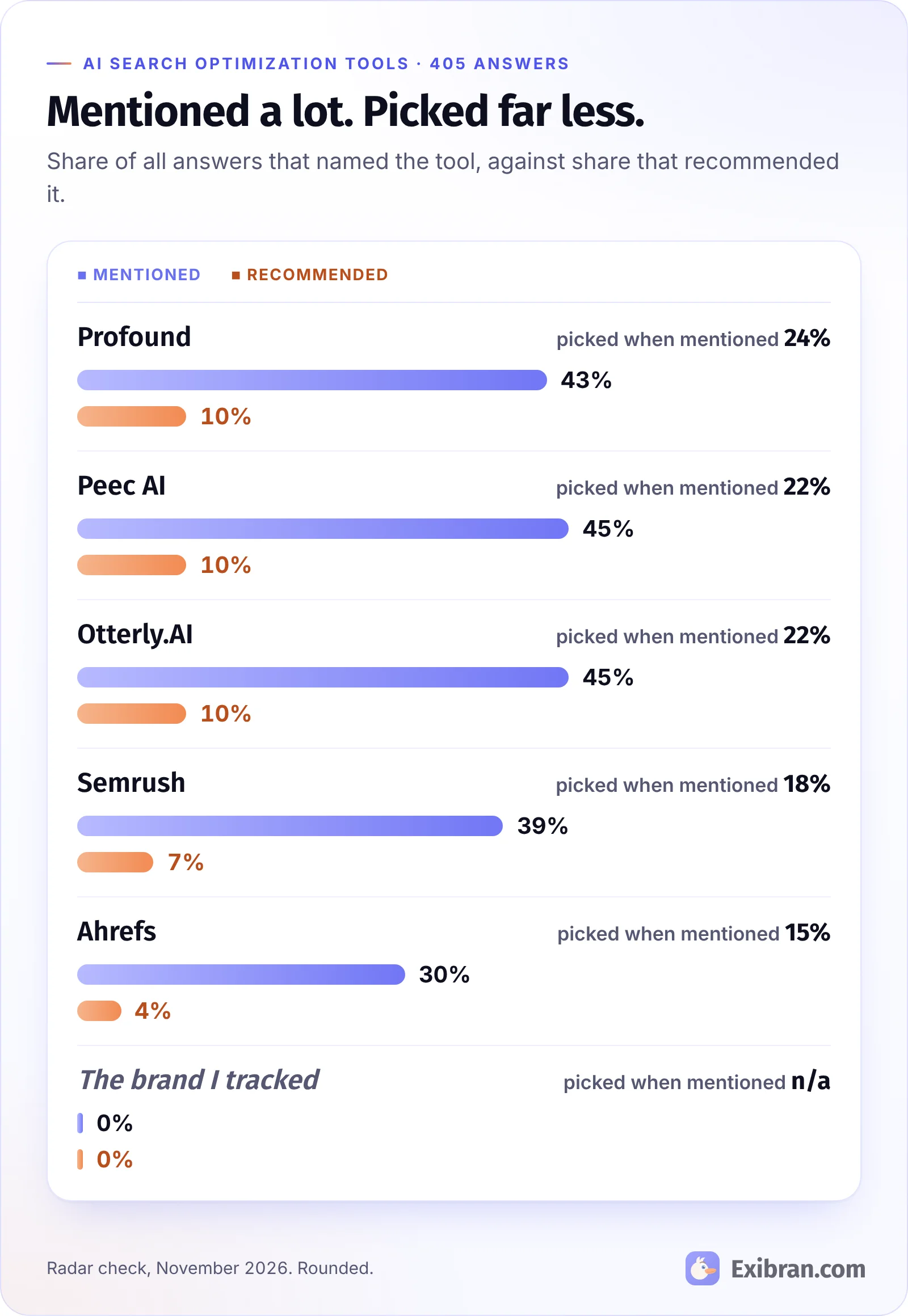
One caveat. Nine of the 27 questions name tools, such as "X vs Y", which lifts those tools' numbers.
On the questions that name no tool at all, picks fall to 3% to 7% while mentions stay at 36% to 40%. The gap does not close.
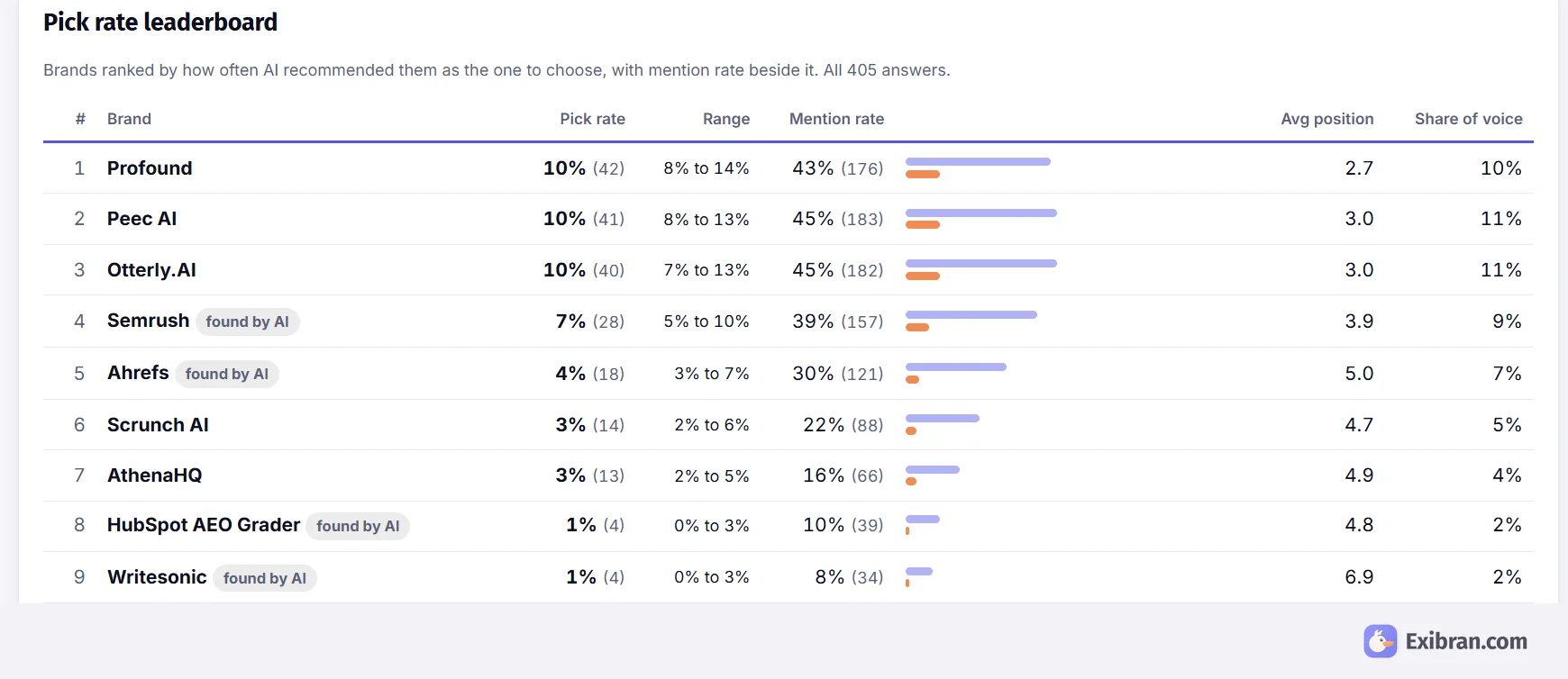
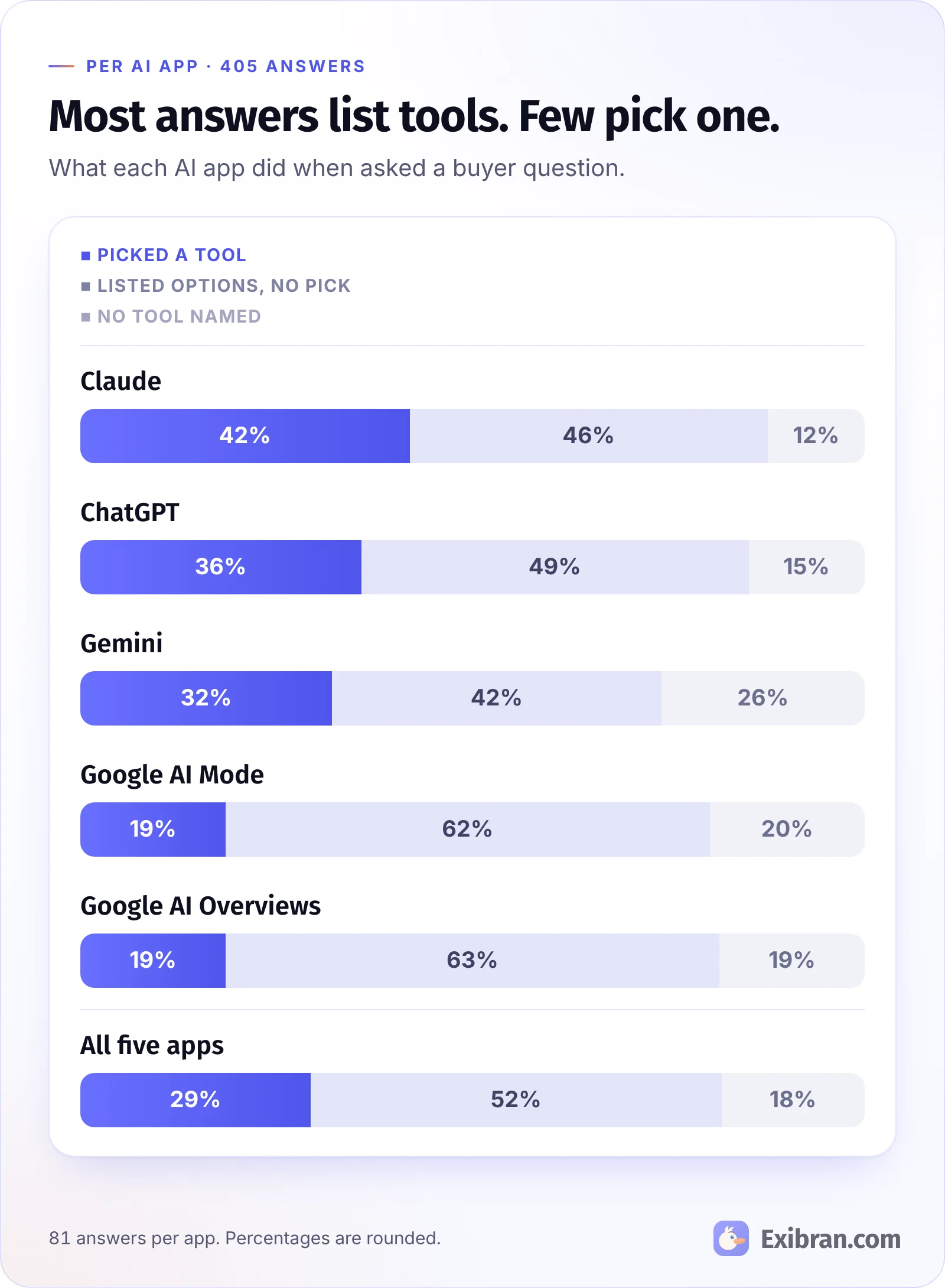
Most AI Answers Picked Nothing
Only 119 of the 405 answers (29%) named a winner. 212 (52%) listed options and stopped. 74 (18%) did not name a single tool.
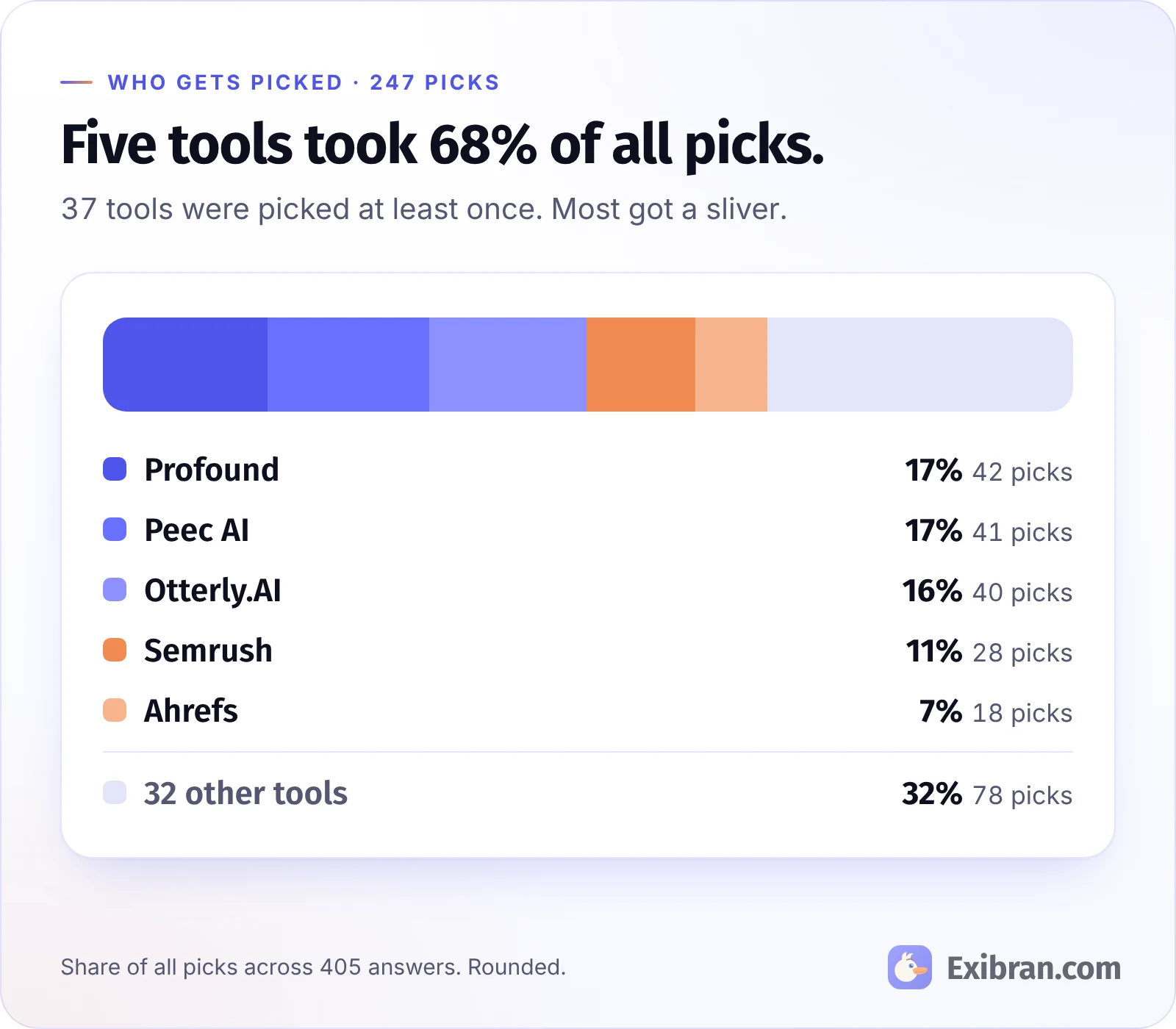
Then the picks went to very few names. Five tools took 169 of the 247 picks, which is 68%.
37 tools got at least one. If you are a small SaaS, you are not competing with 37 tools. You are competing with five.
ChatGPT, Claude And Google's AI Did Not Agree
Claude gave a verdict in 42% of answers. ChatGPT in 36%. Gemini in 32%. Google AI Mode and Google AI Overviews gave one in 19% each, about one answer in five.
The same tool can win on one app and vanish on another. Otterly.AI was picked 18 times in Claude's 81 answers and 2 times in Google AI Mode's 81.
So track a pick rate for each app, then one overall number. Never blend them without showing the split.
Automatic Tags Were Wrong A Lot
Exibran Radar tags every answer automatically. Then I checked the tags against the answer text. Of the 450 answers, 390 needed a brand removed or merged, and 112 needed their recommendation changed.
The software counted AI apps like ChatGPT and Claude as tools. It counted headings like "Caveats" as brands. It even treated a plain acronym as the brand, as in the screenshot below. I have since fixed that.
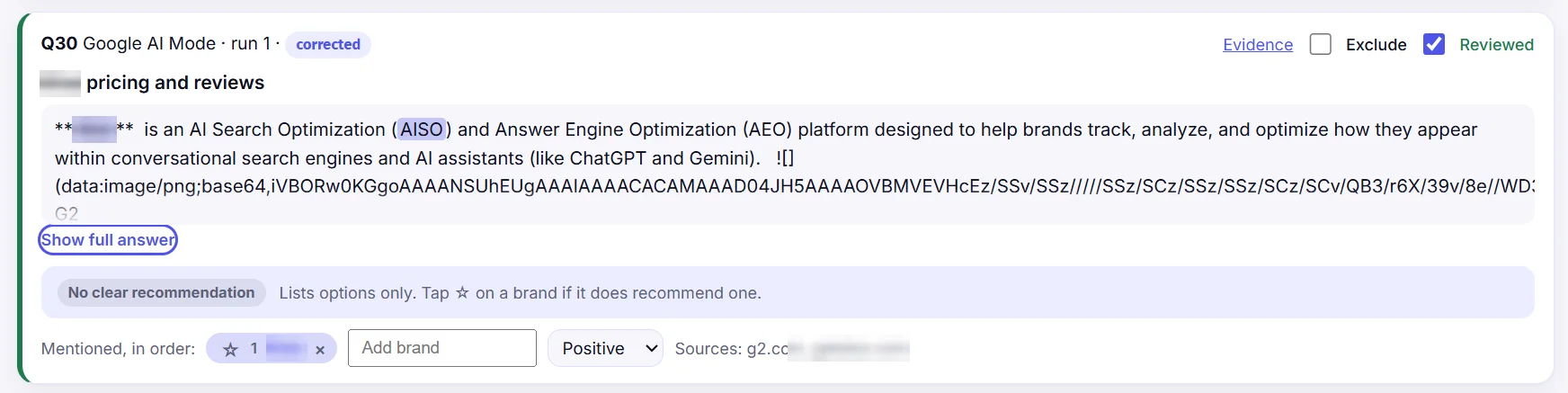
Names can also clash for real. In all three Claude runs of one question, the answer listed an unrelated web hosting company with a similar name as a second result. If your name looks like another company's, check for this.
I re-run this check every four to six weeks and update this post when the numbers move.
Why Doesn't Your Google Ranking Show Your AI Pick Rate?
Because ranking well on Google and being mentioned by AI are two separate games. My client lived it. Strong rankings, little traffic, and no say in what AI told buyers.
A SaaS founder posted: number one on Google for several keywords, never mentioned when they ask ChatGPT their customers' questions.
Another poster tested 48 SaaS brands and found that in every category the top two or three got nearly all the AI suggestions. Treat that as one person's test. My 405 answers point the same way.
The unfair part is also the good news. AI does not simply pick the biggest company. It picks the one it has read the most useful things about. You can change that.
Why Can't You Just Track Your Rank In ChatGPT?
Because there is no stable rank to track, which is why AI Pick Rate counts verdicts instead.
In a study by SparkToro and Gumshoe.ai (opens in a new tab), about 600 volunteers ran the same 12 prompts through ChatGPT, Claude and Google's AI nearly 3,000 times. The same list of brands came back less than once in 100 answers. The same list in the same order came back about once in 1,000.
Rand Fishkin, co-founder and CEO of SparkToro, put it bluntly: any tool that gives a "ranking position in AI" is "full of baloney."
What did hold steady was how often a brand showed up at all. Some brands appeared in 60% to 90% of answers for a given need, even while their position kept moving.
So stop asking "where do I rank?" Start asking "how often do I appear, and how often am I the pick?" That second question is AI Pick Rate.
How Do You Measure Your AI Visibility And Pick Rate?
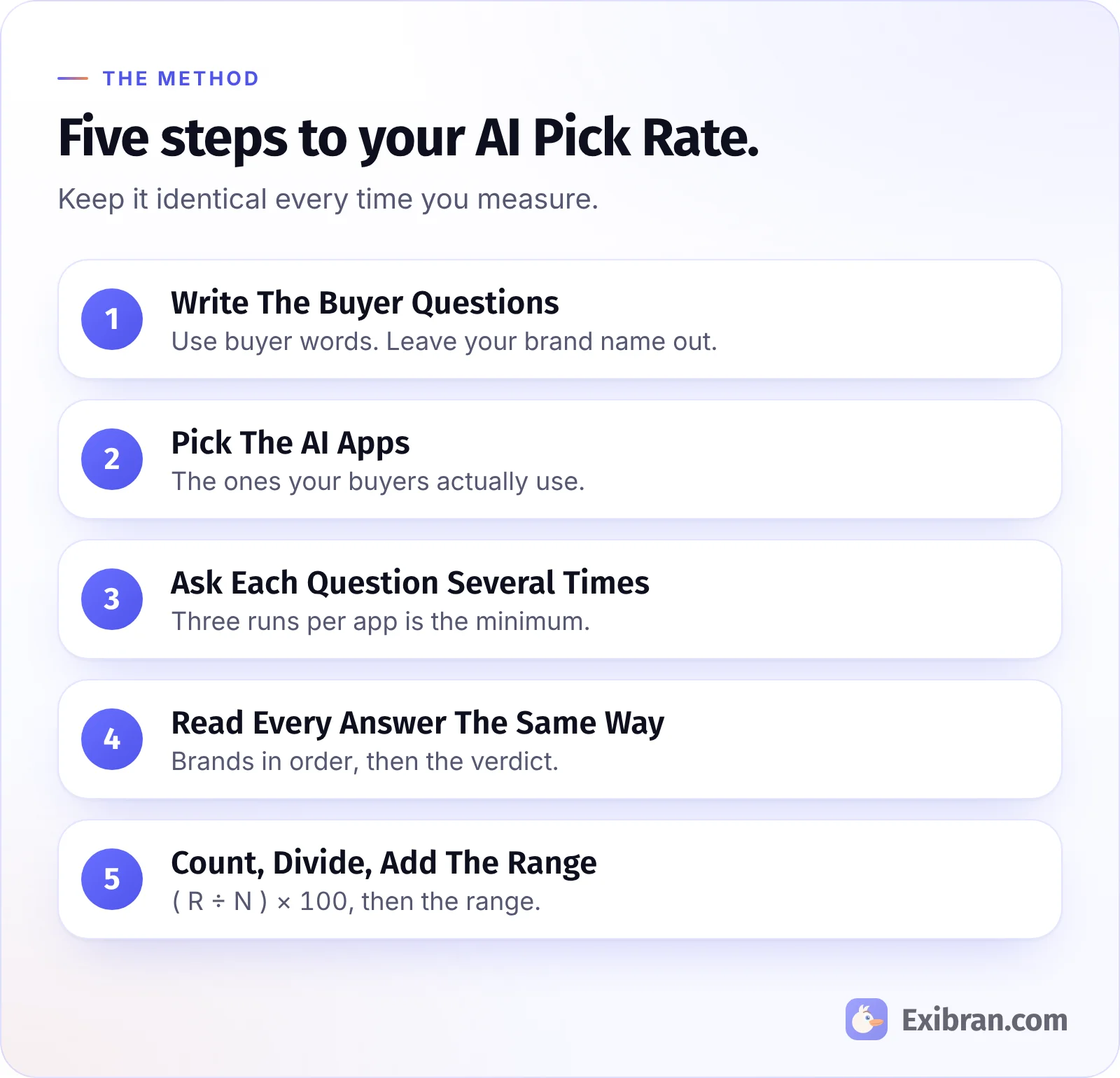
Five steps. The method matters more than the tool, so keep it identical every time you measure.
- Write The Buyer Questions. Use what real buyers ask before choosing: "best X for Y", "X vs Y", "alternatives to X", plus price and trust questions. Leave out any question that names your brand, or you inflate the result.
- Pick The AI Apps. Choose the ones your buyers use, such as ChatGPT, Gemini, Claude and Google's AI features. Collect answers from the real apps where you can.
- Ask Each Question Several Times On Each App. Three runs is a sensible minimum, because a single answer proves nothing.
- Read Every Answer The Same Way. Note each brand in the order it first appears, then what the answer recommends, if anything.
- Count, Divide, And Add The Range. Pick rate = recommended answers ÷ all answers. Then work out the plausible range.
How Do You Check If ChatGPT Recommends You Now?
You can check if ChatGPT recommends you manually in two ways.
Switch On the ChatGPT Temporary Chat Feature
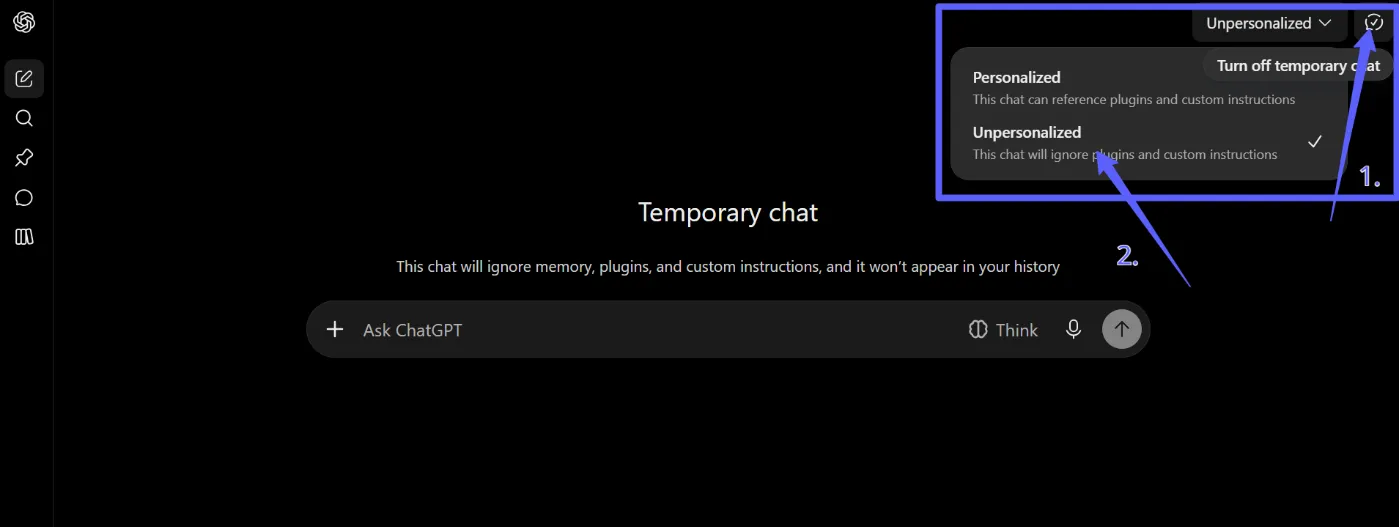
Open ChatGPT (opens in a new tab) and start a Temporary Chat, so your history does not shape the answer.
Change the Personalized option next to it to Unpersonalized, as shown below.
Ask a buyer question without your brand name. Example: "What is the best [category] tool for a [size] team?"
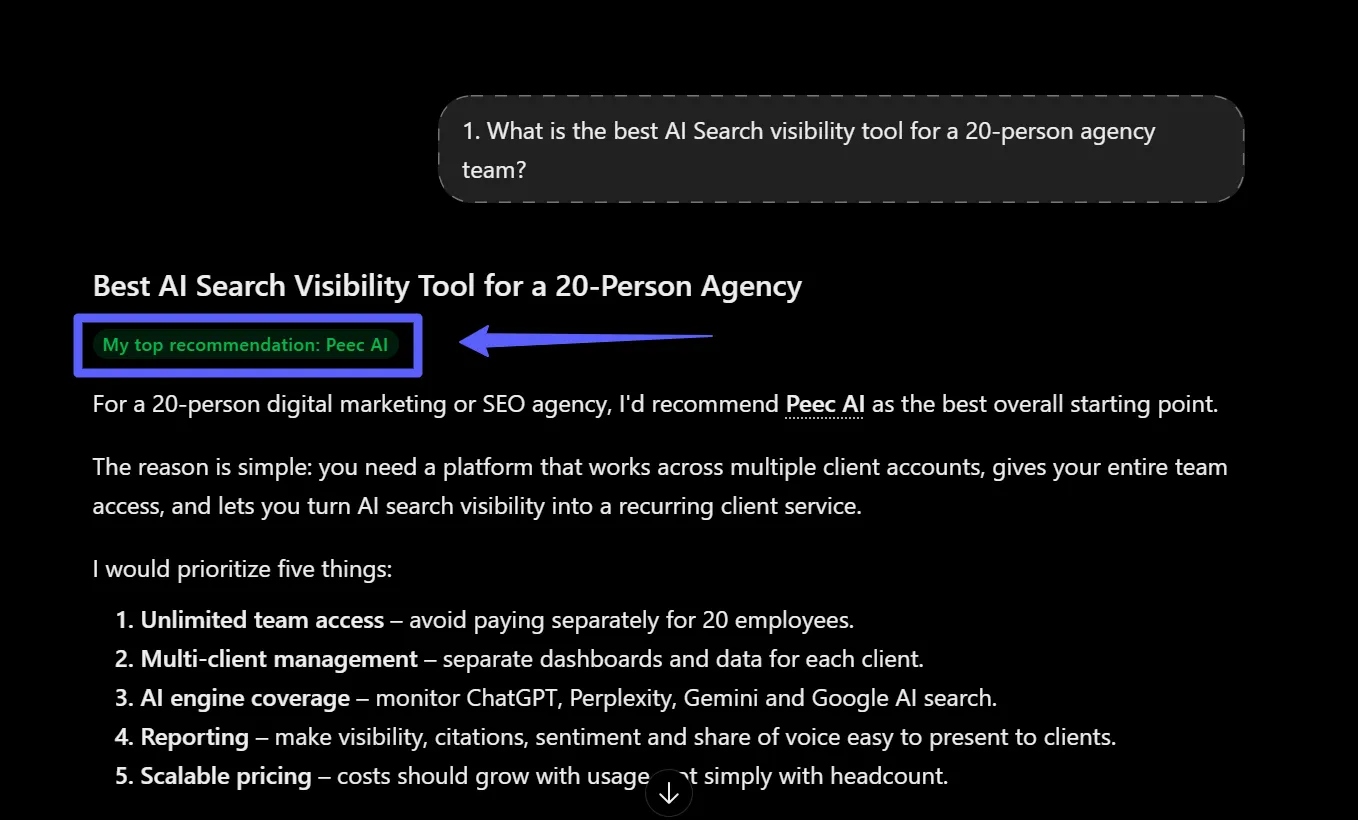
Write down every brand it lists, in order.
Write down the verdict. Who does it tell you to choose?
Open a new chat and ask the same question again. Repeat three times.
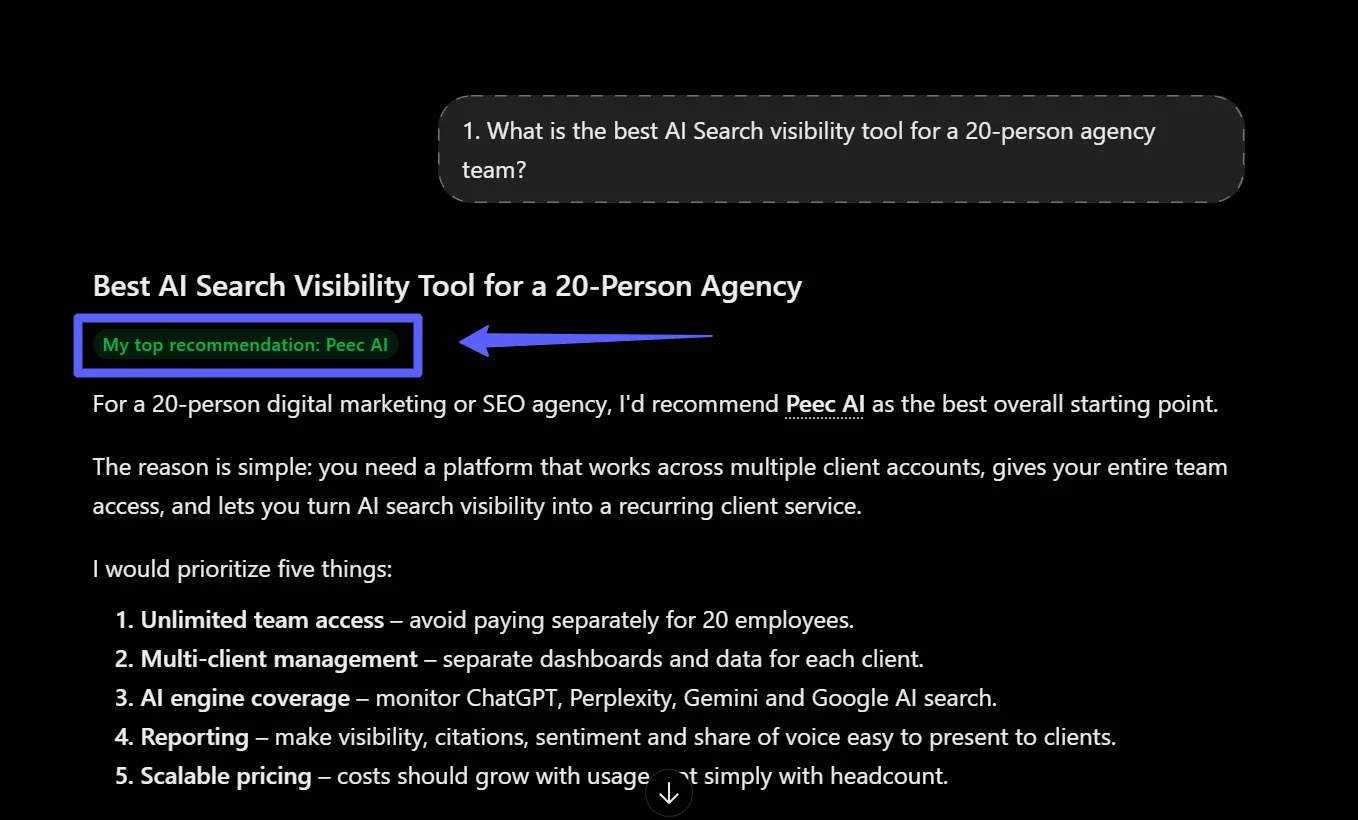
Remember that the previous chat disappears once you switch to a new one. Before you do, make sure you have the information you need.
Use Incognito, or Switch to Another Browser While Logged Out
Sometimes I switch to Chrome Incognito, or even to another browser like Bing, logged out.
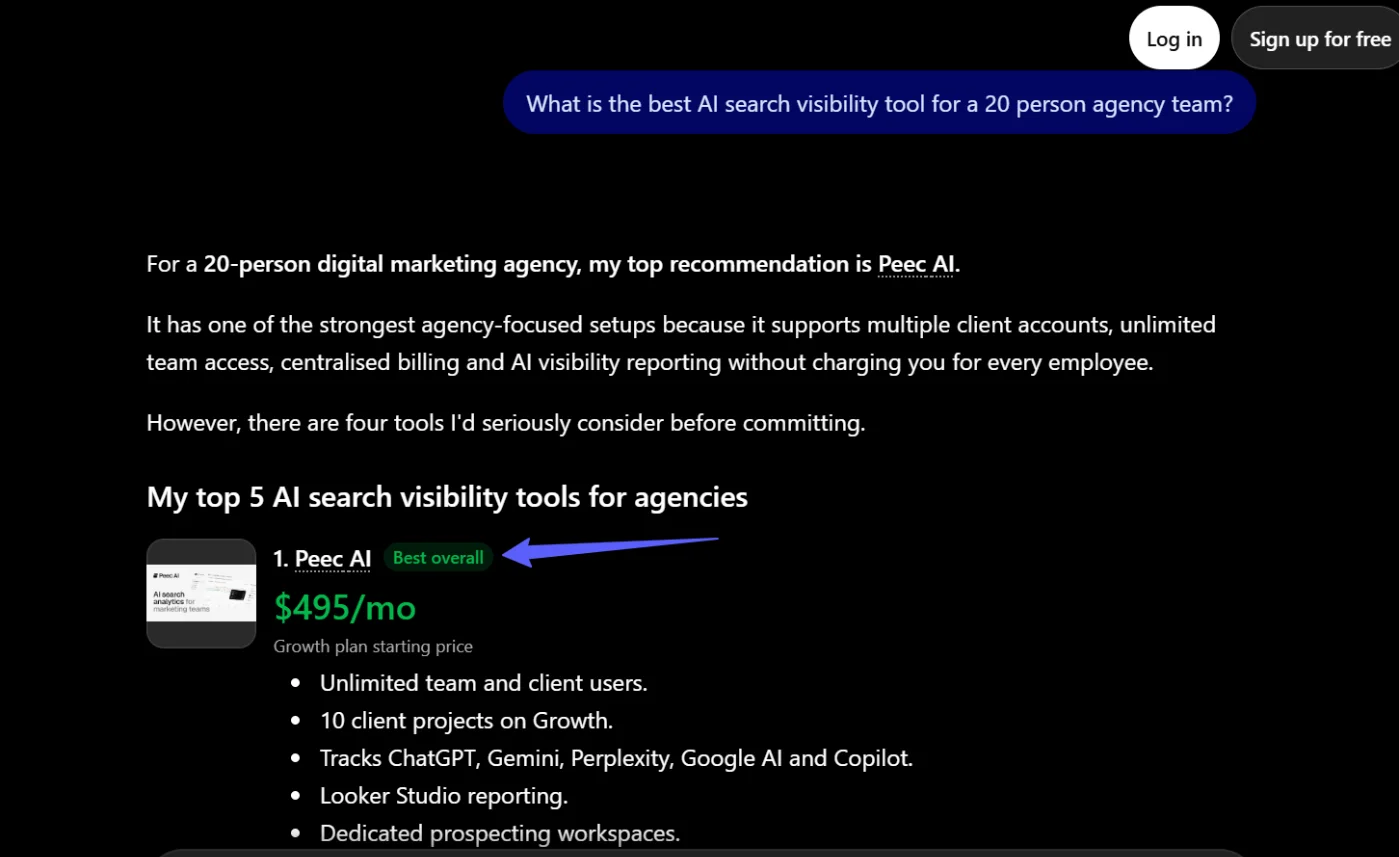
You might be asked to log in, but don’t. Follow the same process as above. Clicking on a new chat will remind you that the previous one will be removed, so get the necessary information before you agree.
When you are done, put it in a sheet with four columns: question, run, listed you (yes or no), recommended you (yes or no).
This is rough. Three answers cannot give you a rate, but it shows you the pattern and the gap.
What Counts As A Recommendation?
This is where most measurement goes wrong, so be strict.
It counts when the answer says:
- "I'd recommend X" or "I'd go with X"
- "Best overall: X" or "My top pick is X"
- "For your team, X is the best fit"
- "For small teams X, for enterprise Y". Both count, as a pick that depends on needs.
It does not count when:
- You are listed, even first
- You are described positively, but nobody is chosen
- You are mentioned in a comparison without a verdict
- The answer only lists options. Record these as "no pick". They tell you AI sees no clear winner yet.
How Many Answers Do You Need To Trust Your Pick Rate?
More than you think. Because answers vary so much, a pick rate is an estimate, and the honest way to show it is with a range.
Here is how wide the range is for a 15% pick rate at different sample sizes:
| Answers Collected | A 15% Pick Rate Really Means | Width Of The Range |
|---|---|---|
| 30 | 6% to 32% | 26 points |
| 90 | 9% to 24% | 15 points |
| 270 | 11% to 20% | 9 points |
| 540 | 12% to 18% | 6 points |
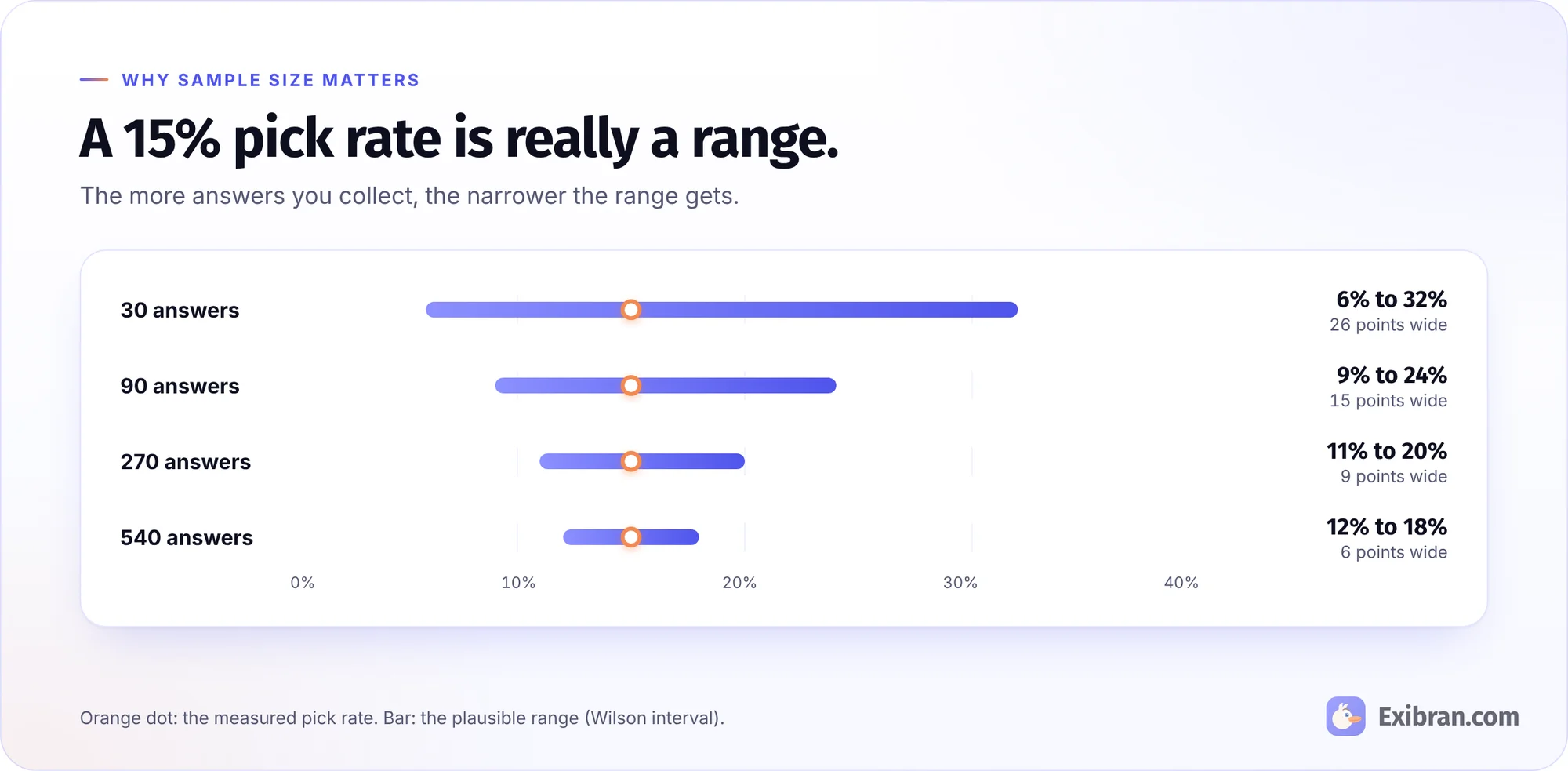
The ranges use the Wilson score interval (opens in a new tab), a standard way to estimate a rate from a sample. My rule for calling a change real: it has to move by more than 7 points, and the ranges must stop overlapping.
Even a zero has a range. In my test, 0 picks in 81 answers on one app still means somewhere between 0% and 5%.
What Is A Good AI Pick Rate?
There is no universal benchmark for AI Pick Rate yet, and anyone quoting one without their method is guessing.
In my test, the best tool in a whole category was picked in 10% of answers. So do not chase 100%.
Measure yourself against the brand AI picks most for your questions. If the leader is picked in 30% of answers and you are picked in 10%, that 20-point gap is your real target. You can show it to your CEO without apologising for the data.
Where Does AI Read About Your Brand?
Not only on your website. In my 405 answers, these were the pages AI cited most:
| Source | Answers That Cited It |
|---|---|
| reddit.com | 18% |
| tryprofound.com | 16% |
| otterly.ai | 14% |
| peec.ai | 12% |
| semrush.com | 11% |
| youtube.com | 11% |
Community threads and video sit right beside the tools' own sites. Behind them came a long tail of editorial and comparison sites.
Your own page helps, but it does not decide. When an answer cited a tool's own site, AI picked that tool in 13% to 34% of those answers. Across all answers, the same tools were picked in 3% to 10%.
So the page lifts you. Even then, AI picked the tool it was citing only about a third of the time at best. Correlation is not proof, but it points the same way as Ahrefs' study of 75,000 brands (opens in a new tab), where branded web mentions correlated with AI Overview visibility at 0.664, against 0.218 for backlinks.
How Do You Raise Your AI Pick Rate?
Once you have your number, start by finding out why AI prefers the other brand. Do not guess.
One founder on Reddit described an audit where the competitor won for a simple reason: they had a page that answered the exact buyer question, and the founder did not. AI sent buyers to whoever had written the answer.
In practice, the brands that get picked tend to have:
- Reviews and listings on the sites AI cites for their category
- Comparison and "alternatives to" pages that answer the buyer's real choice
- A clear, honest answer to the objection AI keeps repeating about them
- A website AI crawlers can actually read
Measure first. Then fix what the measurement shows. If you want the numbers for your own product, the free check runs this method for you.
Can AI Crawlers Read Your Site?
Check your robots.txt for each of these. Blocking a search bot can stop that AI app from quoting you.
| Bot | What It Does | What To Do |
|---|---|---|
| OAI-SearchBot | Finds pages for ChatGPT search | Allow it |
| ChatGPT-User | Fetches a page when a person asks ChatGPT to | Allow it |
| Claude-SearchBot | Indexes pages to improve Claude's search results | Allow it |
| Claude-User | Fetches a page when a Claude user's question needs it | Allow it |
| PerplexityBot | Perplexity's crawler | Allow it |
| GPTBot and ClaudeBot | Collect content that may be used to train models | Your choice. It does not decide whether AI search can find you. |
| Google-Extended | Controls whether Google uses your content for Gemini | Your choice. Google says it does not affect Search. |
Google says no special files or markup are needed for AI Overviews or AI Mode (opens in a new tab). Other AI apps do reward clear structure, so write plain headings, direct answers, and tables.
DIY, Tracking Tool Or Done For You? Checking for AI Visibility
You do not need a big platform to start. Here are three ways to get your AI Pick Rate, and what each is good for:
| Approach | DIY | A Tracking Tool | Done For You |
|---|---|---|---|
| Best For | Your first baseline | Ongoing monitoring at scale | The number and the fix |
| What You Get | A rough pick rate from 30 to 90 answers | A dashboard, usually built on mentions | Every answer saved and read, pick rate with range, the competitor AI picks instead of you |
| Watch Out For | Wide ranges and tagging mistakes | Scores that differ between tools. Check it reads the verdict, not just the mention. | Ask to see the questions, apps, dates and runs behind the number |
| Time To A Number | An afternoon | Setup, then a monthly plan | 48 hours for the free check |
One Indie Hackers founder who compared tools said the cheapest was $29 a month and most were $300 or more.
One poster on Reddit said every tool gave a different visibility score for the same brand.
So know what your tool counts. And remember that a score alone is not enough: it tells you how sick you are, not what to do next.
How Do You Track Your AI Search Traffic On Your Website?
You will only catch part of it. But catch that part. There are three ways.
Filter For AI Apps In Google Analytics 4
Two minutes in GA4:
Go to Reports → Acquisition → Traffic acquisition.
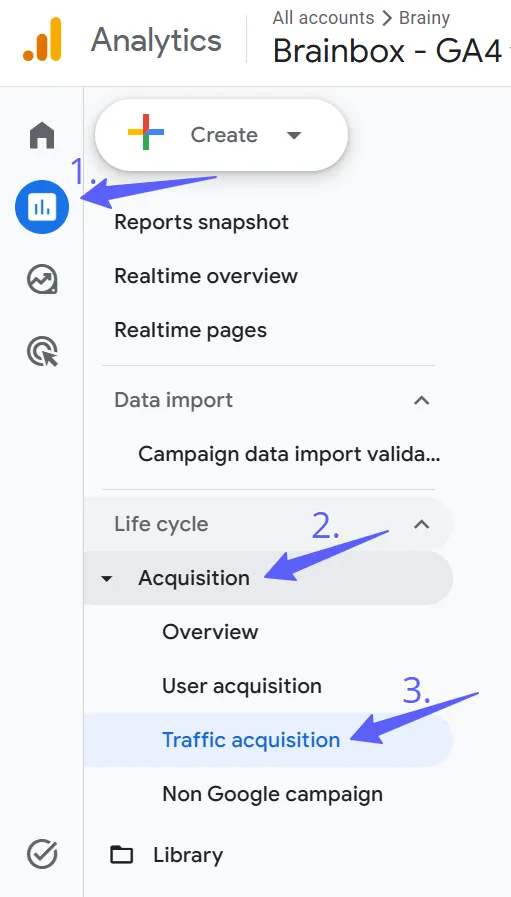
Click the filter and choose Session source/medium.
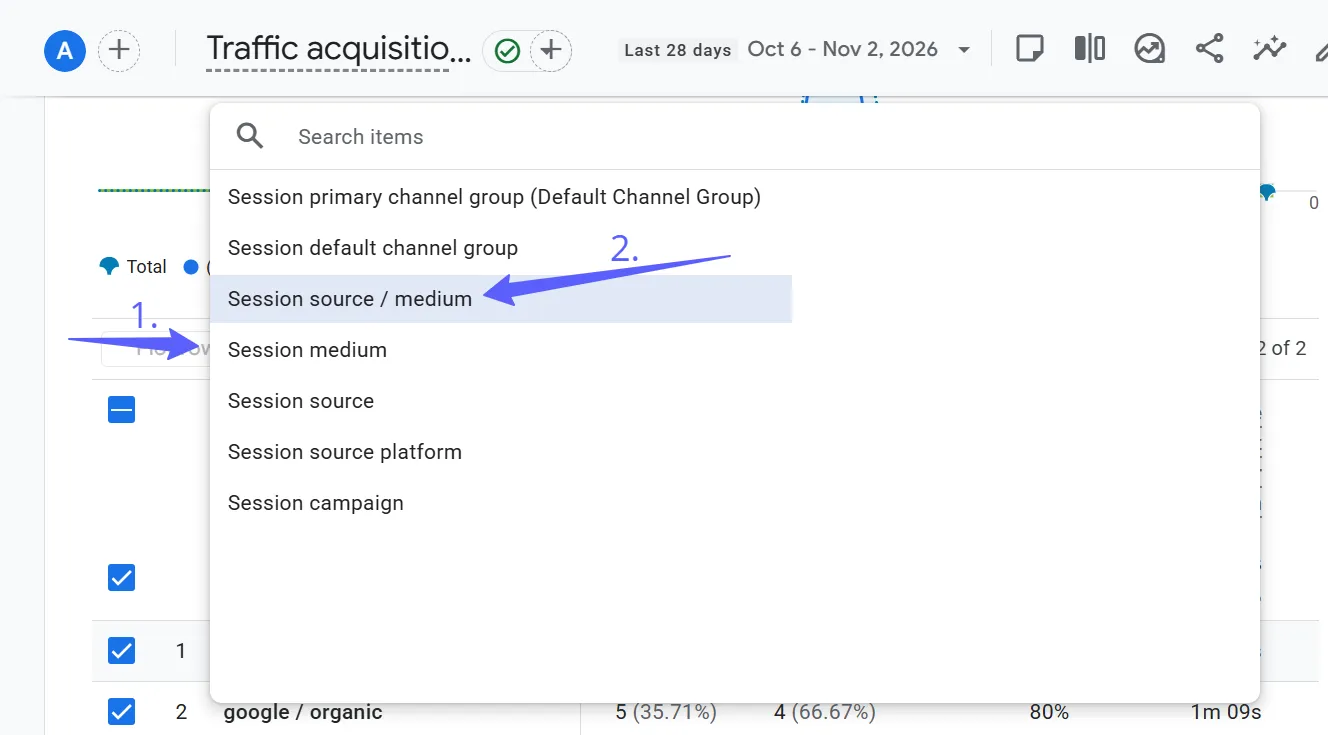
Then, click the + icon next to the filter and select Traffic source → Session source.
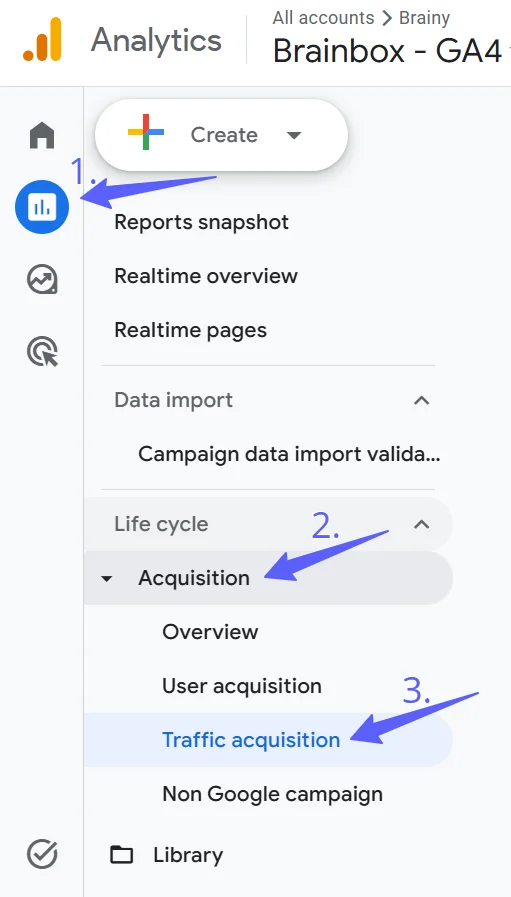
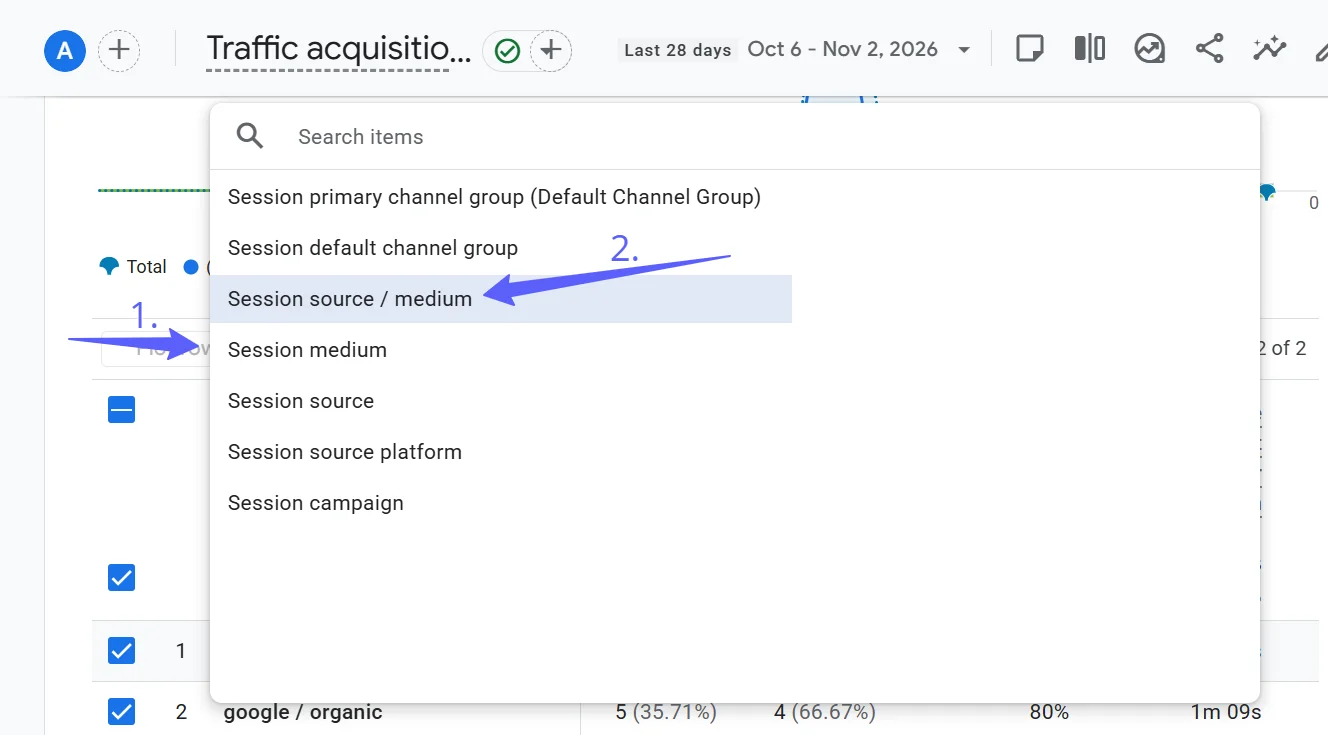
Now you can see visits that arrived from AI apps. Some AI traffic shows up as direct, so this is a floor, not a total.
Ask “How Did You Hear About Us?” On Your Form
On your sign-up or demo form, add the question “How did you hear about us?” with an option called An AI assistant (ChatGPT, Perplexity, Gemini...).
It is the same question on my own free check form.
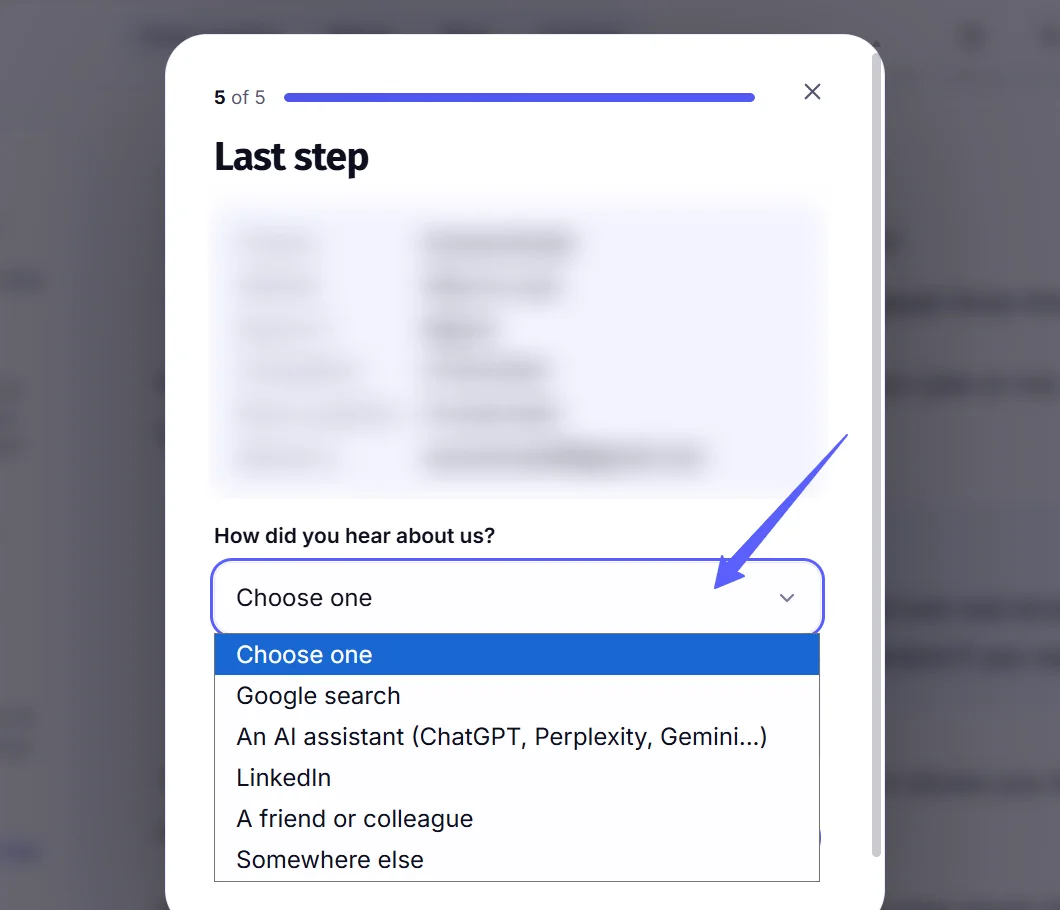
Several founders in my research said customers told them they found them through ChatGPT while analytics showed nothing. This catches it.
Check The Generative AI Reports In Search Console
Google has started adding AI reports to Search Console. In June 2026 it began rolling out generative AI performance reports (opens in a new tab) to a subset of sites.
You will find it in Google Search Console → Performance → Generative AI.
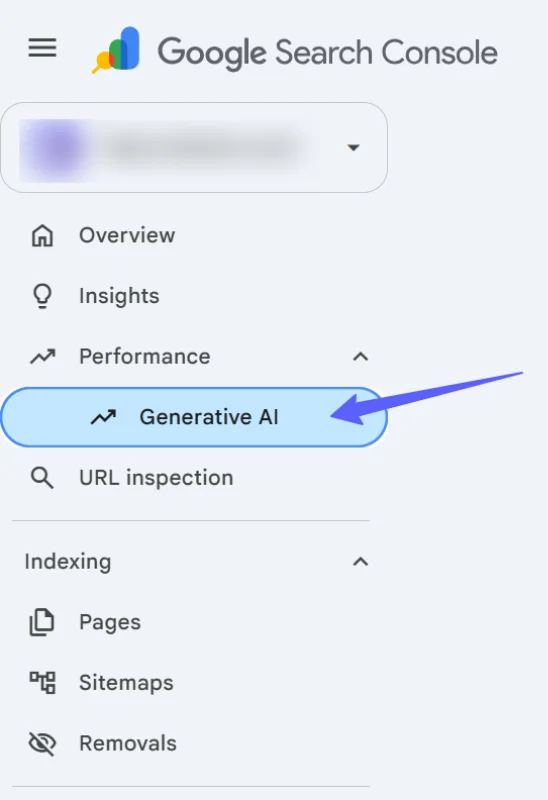
They cover Google's own AI features only, such as AI Overviews and AI Mode.
There is nothing for ChatGPT, Perplexity, or Claude. For those, your own filter and your own form are the best you have.
How Do You Check If AI Describes You Correctly?
A mention can hurt you if it is wrong. Check every answer that names you:
- Price. Is it right?
- Features. Does it claim things you do not have, or miss things you do?
- Who you are for. Does it match your real buyer?
- Mix-ups. Is it describing a different company?
Mark each answer right or wrong in your sheet. For every wrong one, find where AI could have learned it.
Usually it is an old review, an old pricing page, or a third-party list. Fix the source, then measure again in six weeks.
Where Should You Start With AI Pick Rate?
Start with the baseline. One fixed set of questions, three runs, every answer saved. Then you have something to beat in six weeks.
That is exactly what I do for B2B SaaS teams at Exibran, and you can see how on the services page. The free check gives you:
- The real answers from ChatGPT, Gemini and Perplexity, word for word
- Your pick rate and its range, not just a score
- The competitor AI picks instead of you, and the reason it gives
- Two quick fixes you can ship this week
You send your product name. I send the result within 48 hours.
Frequently asked questions
Is AI Pick Rate the same as share of voice?
No. Share of voice counts how much of all brand mentions are yours. Pick rate counts how many answers chose you as the one to buy. A brand can hold a big share of voice and still almost never be the pick.
Can I measure my pick rate by asking ChatGPT myself?
Only roughly. A few asks gives you a few answers, and AI lists change almost every time. You need the same questions asked many times, across several AI apps, with every answer saved and read the same way.
How often should I measure it?
Once to set a baseline, then every four to six weeks with the same questions. Measuring more often mostly measures noise, because AI answers move around even when nothing has changed.
Does a high mention rate mean a high pick rate?
No. In a test of 405 AI answers about AI search optimization tools, the most mentioned tools appeared in 43% to 45% of answers and were picked in 10%. Being known is not the same as being chosen.
What is a good AI Pick Rate?
There is no universal benchmark. In my 405-answer test, the best tool in its category was picked in 10% of answers. Measure yourself against the brand AI picks most for your own buyer questions.
Published
Add Exibran as a preferred source on GoogleJoin the conversation
Comments
Comments are closed on this post.
Bran’s waiting for the first comment
Ask a question, share what AI says about your brand, or tell Michael where you disagree. You will get a reply.